

BuyingTime in 30 Seconds
George Bamford takes on a major role at JCB while keeping his watch businesses moving. Louis Vuitton revisits the Monterey in ceramic, Marco Tedeschi puts a floating tourbillon against black aventurine, and Ianos and Yema offer distinctive titanium divers. Our features connect Victorian royal patronage, a musician’s collecting instincts and the industrial expertise behind modern movements. An affordable tourbillon raises questions about what a low price includes, while New York prepares for a packed October watch calendar. Yesterday’s F.P. Journe Élégante remained unsold despite a US$117,500 bid. Today, a rose-gold Bovet Récital 0 tourbillon closes at 1:40 p.m. EDT.
Time Graphing Today’s Watch Universe
Seeing Through the Watch—and the Price
There is an appealing coincidence in today’s issue. Several watches invite us to look directly through them, while several other stories ask us to look past what we think we already know. Sapphire cases expose the machinery. Skeletonized movements turn construction into decoration. A reluctant Rolex wearer discovers something attractive in a modest vintage reference. An inexpensive tourbillon challenges the assumption that a rotating cage must come with an intimidating invoice. Taken together, these stories suggest a useful collecting habit: look beneath the first impression.
That applies especially to price. Yesterday’s F.P. Journe Élégante attracted a bid of US$117,500 and still did not sell. We do not have the reserve, so we cannot calculate how far apart the two sides were. We do know that a substantial expression of buyer interest was insufficient to complete the transaction. The distinction matters. An unsold watch has produced information about that auction, but it has not established a sale price simply because a large number appeared beside it.
Today’s review of the US$850 Atelier Loreti tourbillon approaches the same subject from the opposite end. Here, the question is how much mechanical spectacle a relatively small amount of money can buy. The answer appears to be quite a lot, provided the buyer accepts compromises in legibility, strap quality, power reserve and the uncertainty of future servicing. A tourbillon can be fascinating without making the entire watch an equally convincing proposition. The complication gets our attention; the ownership experience has to keep it.
At the other extreme, Marco Tedeschi’s Central Floating Tourbillon in black aventurine makes its movement architecture the principal event. The pleasure comes from the arrangement of components, the sense of depth and the relationship between the starry surface and the mechanism above it. Comparing that watch with an entry-level tourbillon by checking whether both have a rotating escapement would tell us very little. Design, execution, finishing and the ambition of the construction require their own examination.
The roundup of transparent sapphire watches takes visibility even further. Removing an opaque case changes the way a watch is experienced: the movement becomes an object that can be examined from several directions. It also makes case manufacturing more demanding. Yet transparency is not an explanation in itself. Seeing more components does not automatically tell us which are difficult to make, how well they have been finished or whether the resulting watch is comfortable to wear. A clear case can still leave a collector with plenty of questions.
One of the most useful counterpoints comes from the story of Josh Smith’s watch collection. A musician accustomed to finding expression through an instrument brings an interesting perspective to watches. The appeal lies in character, construction and the response an object produces, with room for vintage Enicar, Japanese independents and unexpected discoveries. That kind of curiosity gives collecting somewhere to go beyond the next widely approved purchase.
The author warming to a 1974 Rolex Oysterdate Precision arrives at a similar place by another route. A brand can accumulate so much cultural baggage that the individual watch becomes difficult to see. Put a simple 34mm, manually wound Rolex on the wrist, however, and the discussion becomes more specific. Do the proportions work? Does the dial have charm? Does winding it add pleasure or inconvenience? Those are more useful questions than deciding in advance whether one is a “Rolex person.”
History helps explain why this is sometimes difficult. Our feature on Victorian royal timepieces reminds us that watches have long carried messages about status, taste and access. Royal patronage connected technical achievement with social authority. Exhibitions made innovation visible and desirable. Today’s collectors inhabit a different world, but the relationship between craftsmanship and prestige remains familiar. The challenge is recognizing when reputation helps us understand an object and when it starts doing our thinking for us.
Meanwhile, Louis Vuitton’s ceramic Monterey shows how much identity can reside in shape. Its rounded, lugless form survives a change in materials and movement because the underlying design is strong enough to remain recognizable. The Ianos Amfivios makes a different argument, concentrating on titanium construction, water resistance and a strap arrangement designed around use. Both have clear personalities, even though they answer very different desires.
Today’s Bovet auction brings these threads together. The Récital 0 offers precious metal, openworked mechanics and a seven-day tourbillon movement. There is considerable watchmaking to admire. But the price still needs to be considered in the context of condition, service history and the market for this particular reference. An advertised dealer price is useful evidence of what a seller wants; it does not tell us what another buyer has paid.
The opportunity for collectors is to hold these ideas together without allowing one to cancel the others. Enjoy the spectacle. Appreciate the history. Examine the mechanics. Then ask whether the particular watch, at the particular price, makes sense for you. Looking closely should deepen the pleasure of collecting—and occasionally give us the confidence to leave a watch where it is.
-Michael Wolf
News

George Bamford Takes a Bigger Role at JCB—and Keeps His Watch Businesses Running
George Bamford has been appointed joint chairman of JCB, adding a major industrial responsibility to the career of one of British watchmaking’s most recognizable personalities. The appointment signals a larger role in the family construction-equipment business, but Bamford says his watch operations will continue as usual, including new product launches.
Those operations encompass Bamford Watch Department, known for collaborations and customization, and Bamford London, which develops watches under its own name. Both work from the Mayfair headquarters nicknamed The Hive. The story raises an interesting question about how an entrepreneurial watch business evolves when its founder assumes much broader responsibilities, with Bamford’s stated answer being continuity.
Features

Royal Time: How the Victorian Era Changed the Meaning of a Watch
Queen Victoria’s reign coincided with an extraordinary expansion in the reach and importance of precise timekeeping. Railways encouraged standardized time, industry demanded greater coordination, and pocket and pendant watches increasingly connected personal routines with the wider world. Royal patronage added another layer, presenting exceptional timepieces as expressions of craftsmanship, influence and national achievement.
This feature examines the relationship between those practical changes and the luxurious objects associated with Victoria and Prince Albert. The Great Exhibition of 1851 provided a stage for technical ambition, while royal collections and warrants helped confer prestige on their makers. It is a history of watches becoming both more useful and more symbolically powerful.

Josh Smith Collects Watches With a Musician’s Open Mind
Blues guitarist Josh Smith brings the same appetite for discovery to watches that he brings to music. His collecting accelerated during the pandemic and developed across vintage references and independent makers, including Enicar, LeCoultre, Otsuka Lotec, Hajime Asaoka and Masa & Co. The attraction is a mixture of mechanical interest, distinctive design and the satisfaction of finding something that feels personal.
Smith also approaches watches as objects to wear, considering how they suit his hands and his life as a working musician. The interview draws connections between instrument making and watchmaking without reducing either pursuit to brand recognition. For collectors inclined to stay within familiar territory, his enthusiasm offers a persuasive argument for exploring beyond it.

Through the Looking Glass: Watches That Make the Case Disappear
Transparent sapphire cases give watchmakers an opportunity to display their mechanisms as three-dimensional objects. They also introduce substantial manufacturing challenges: sapphire resists scratches exceptionally well but is brittle and demanding to machine. Creating a case that is clear, precisely shaped and structurally sound requires more than substituting one material for another.
Watchonista’s selection explores how brands turn those constraints into distinctive designs. Bell & Ross places its skull architecture inside a transparent enclosure, Hublot adds color to its sapphire vocabulary, and makers including Behrens, Cvstos and Zenith pursue their own combinations of shape and mechanical display. The result is a survey of watches in which the case becomes part of the viewing experience.
A 1974 Oysterdate Precision Makes the Case for Looking Past Rolex Stereotypes
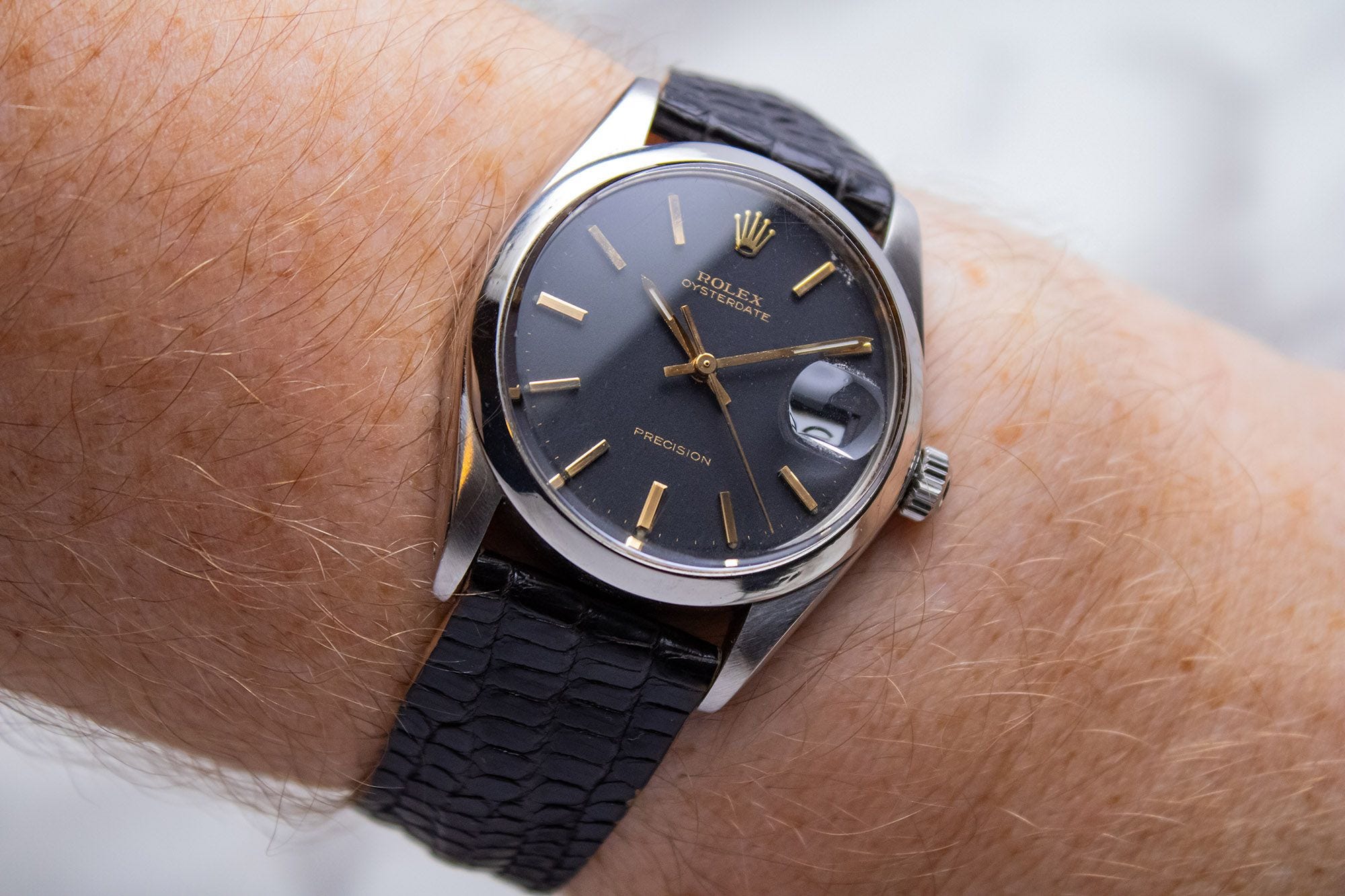
The Rolex Oysterdate Precision ref. 6694 offers a quieter introduction to the brand than many of its celebrated sports watches. This circa-1974 example combines a 34mm stainless-steel Oyster case with a restrained dial and the manually wound caliber 1225. Its dimensions and straightforward presentation make the appeal unusually easy to assess on the wrist.
The author’s initial reluctance gives way to appreciation of the watch’s proportions and vintage character, while acknowledging compromises such as the non-quick-set date. Winding the movement becomes part of the experience, and a period-sympathetic strap reinforces the compact design. The broader lesson concerns keeping an open mind: sometimes an individual watch is more persuasive than the reputation surrounding its maker.

Inside La Joux-Perret: The Industrial Expertise Behind Independent Watches
La Joux-Perret occupies an important position between the small brands that need dependable movements and the industrial capabilities required to produce them consistently. The supplied manufacture visit describes a business combining mechanical calibers, solar-quartz production and high-end work associated with Arnold & Son and Angelus. That breadth makes the company relevant to very different segments of the watch market.
The production approach combines selective automation with skilled assembly and finishing. Repetitive processes can be handled efficiently while technicians concentrate on tasks requiring judgment and dexterity. For collectors, the visit provides useful context for the name appearing in so many specifications: a specialist supplier’s contribution can be central to the quality and viability of the finished watch.
New Watches
Dollar equivalents below are approximate conversions of the supplied European or Swiss prices, rather than confirmed U.S. retail prices. Regional pricing, taxes and import costs may differ.
Marco Tedeschi’s Central Floating Tourbillon Gains a Black-Aventurine Backdrop
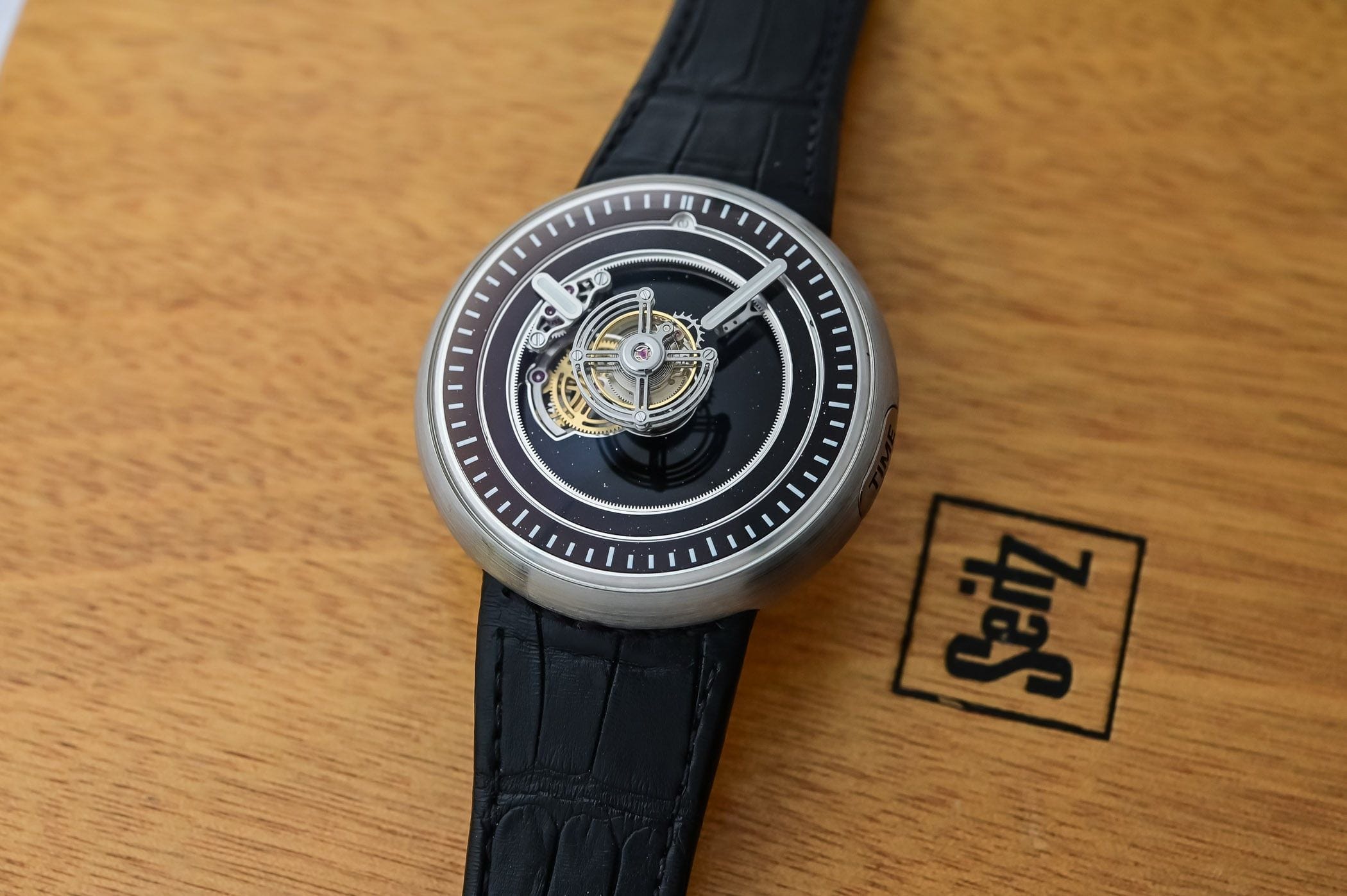
Marco Tedeschi brings a dark, sparkling setting to the Central Floating Tourbillon, using black aventurine to emphasize the depth of its unconventional movement architecture. The 45mm Grade 5 titanium case houses the manually wound KS 7’005 caliber, which comprises 220 components and offers a five-day power reserve. A central barrel helps determine the arrangement of the surrounding mechanism, while the elevated tourbillon, exposed gearing and layered display make the construction the visual centerpiece. The watch pairs a domed sapphire crystal with a black calf-leather strap and titanium deployant buckle, and production is limited to ten numbered examples. Price: approximately US$110,600, converted from CHF92,000.
Baume & Mercier’s Riviera Chronograph Heads to the Historic Italian Grand Prix
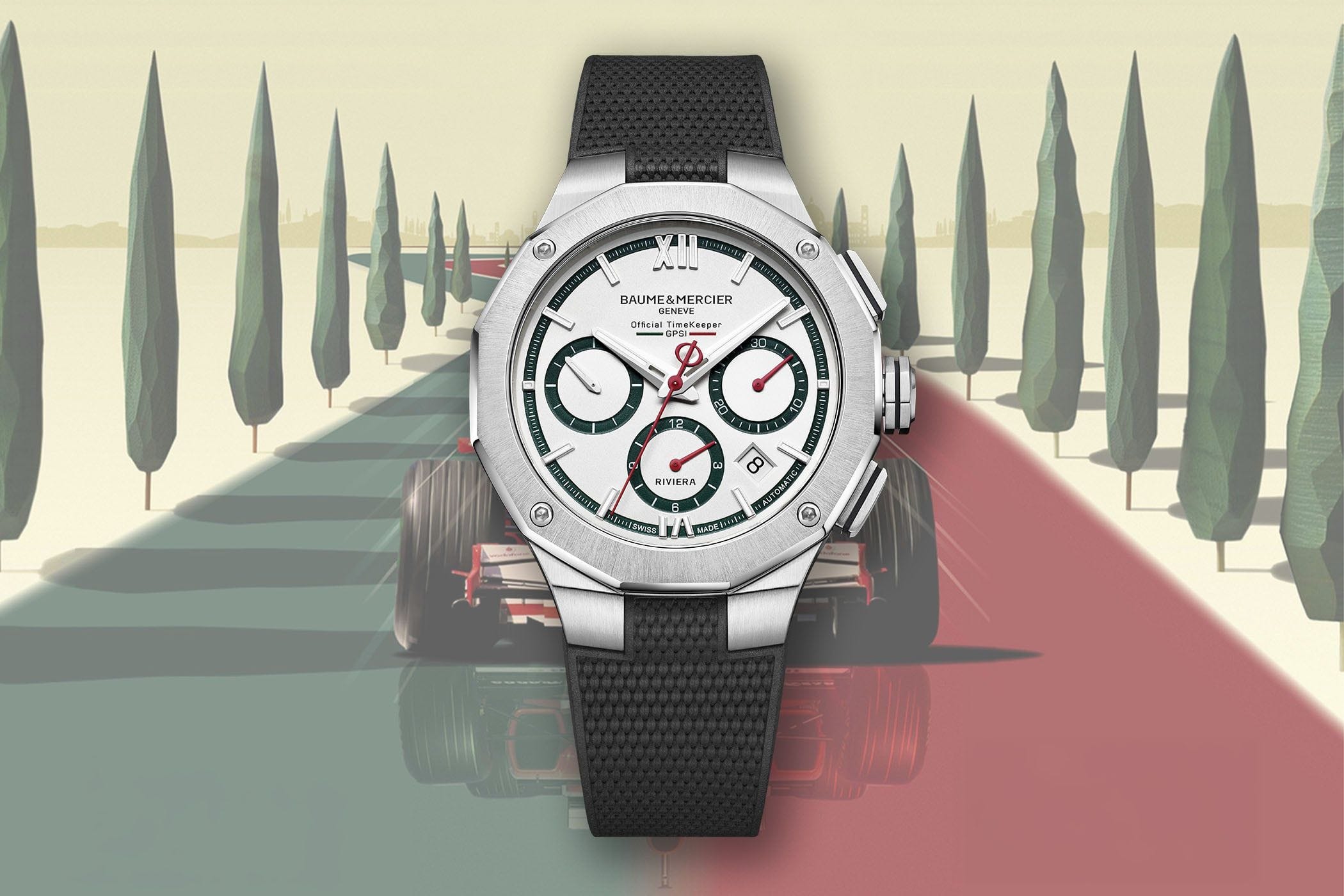
The Riviera Chronograph Gran Premio Storico d’Italia Limited Edition celebrates Baume & Mercier’s role as official timekeeper of the historic motorsport event at Mugello. Its 41mm stainless-steel case retains the collection’s twelve-sided bezel, framing an opaline white dial with green chronograph counters and red timing hands. An automatic Valjoux 7753 movement supplies a 48-hour power reserve, while 100-meter water resistance gives the watch everyday practicality beyond its racing theme. A black rubber strap with canvas detailing and a tool-free change system completes the package, and the sapphire caseback carries the event’s identity. Price: approximately US$5,350, converted from €4,700.
Louis Vuitton Monterey Returns in Green and Black Ceramic
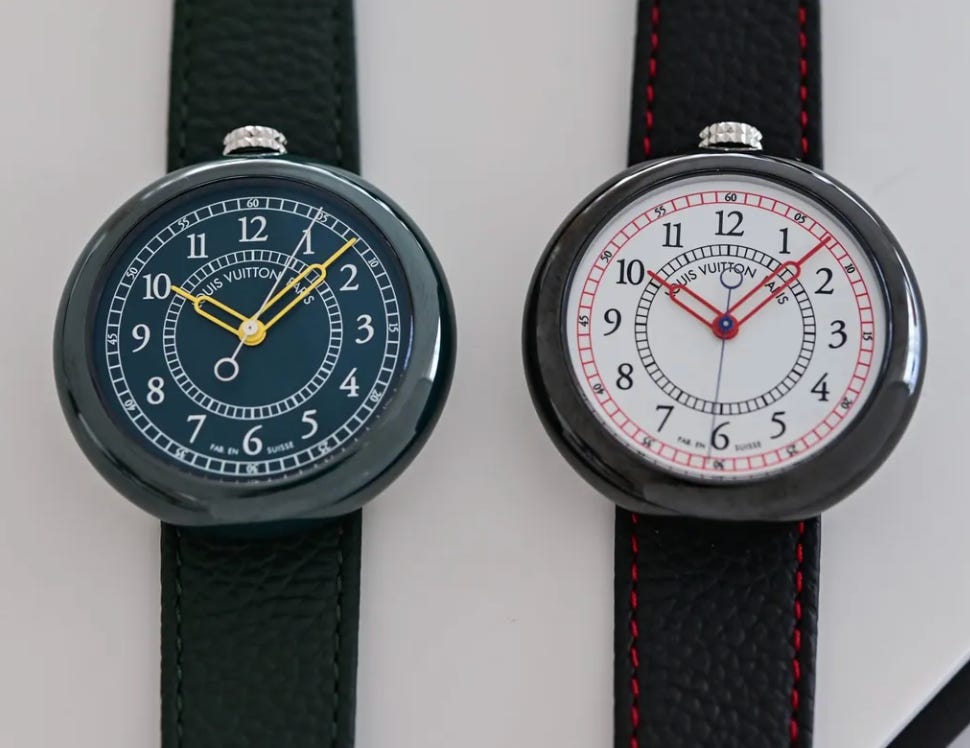
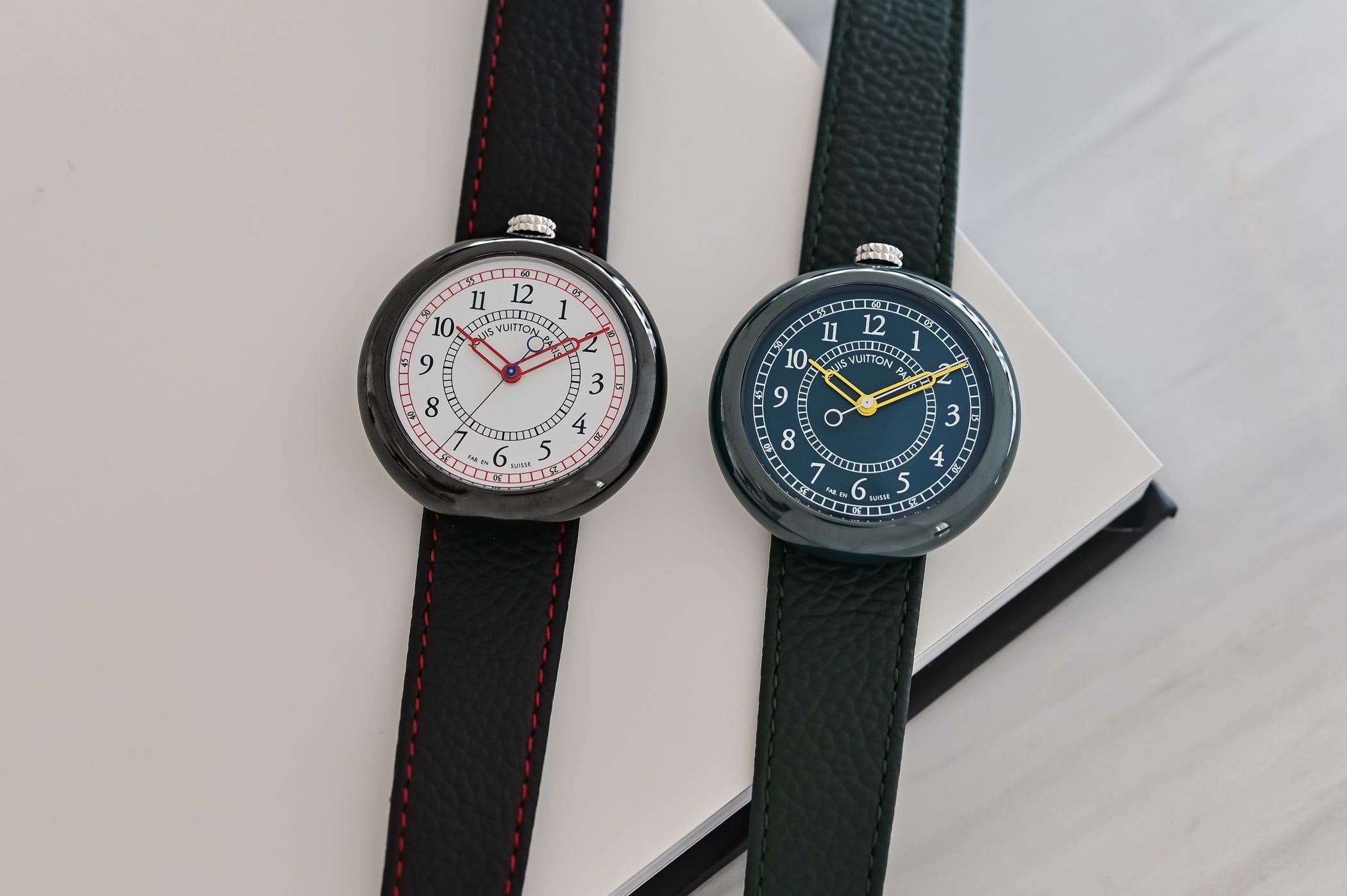
Louis Vuitton revisits its early watchmaking history with two ceramic Monterey references inspired by the LV II of 1988. The 37mm case preserves the rounded, pebble-like silhouette associated with Gae Aulenti’s original design, with concealed strap attachment maintaining the smooth outline. Glossy black ceramic surrounds a white dial, while the green version extends its color across the case, dial and matching calfskin strap. An automatic movement with a rose-gold rotor and 45-hour power reserve updates the proposition, and the display concentrates on timekeeping rather than retaining the original alarm and date functions. Both versions join the permanent collection. Price: approximately US$26,170 each, converted from €23,000.
Ianos Amfivios Brings Purposeful Titanium Construction to Everyday Diving
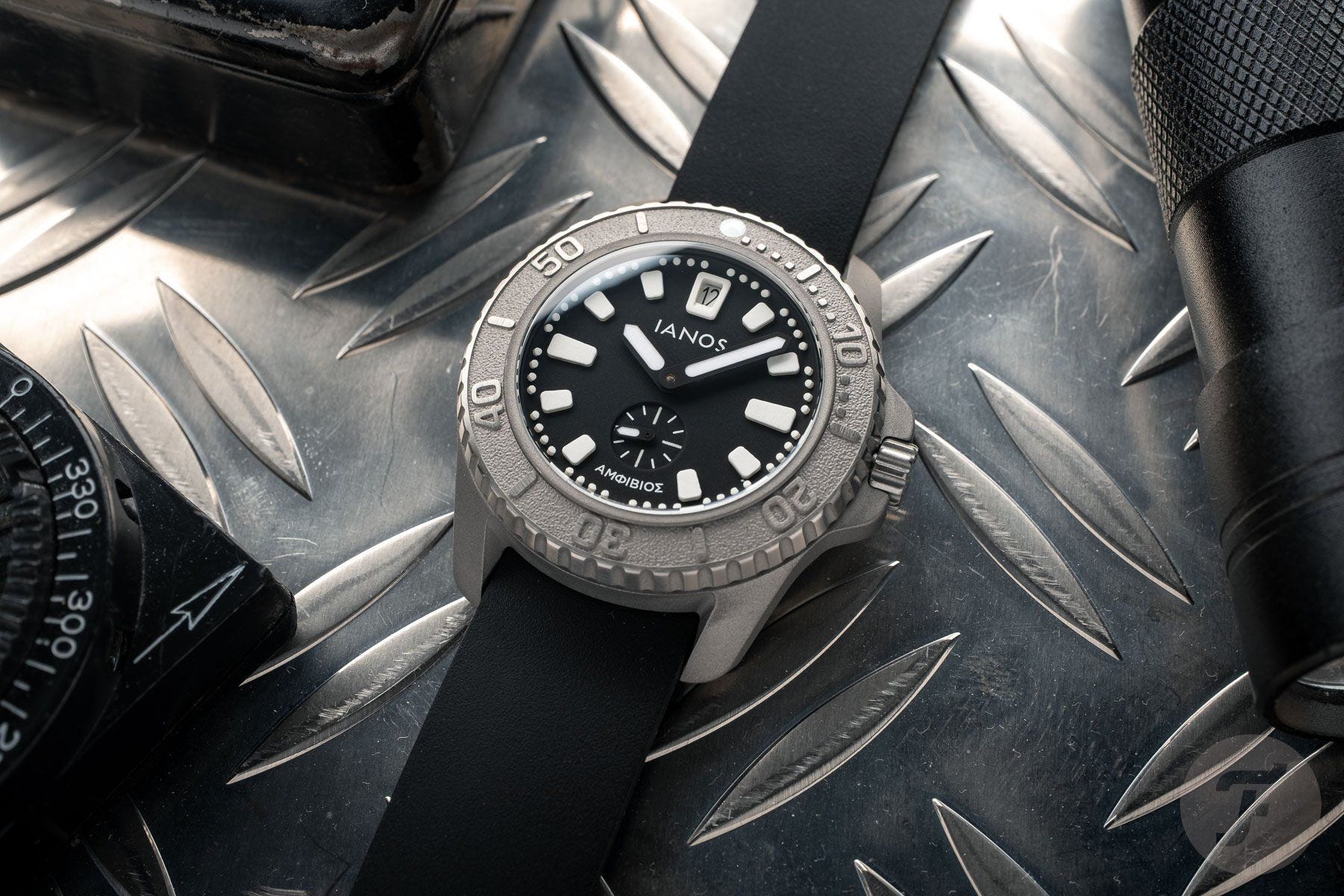
The Ianos Amfivios translates the brand’s functional design approach into a civilian dive watch with a 41mm bead-blasted Grade 2 titanium case. Its matte black dial combines luminous markers with small seconds and a date window at 12 o’clock, creating a distinctive arrangement within an otherwise restrained display. The automatic Sellita SW360 provides approximately 56 hours of power reserve, while a domed sapphire crystal, fixed strap bars and 300-meter water resistance reinforce the practical brief. A channel beneath the case accommodates the rubber NATO strap, and the initial production batch comprises 300 pieces, including 100 numbered watches allocated to existing clients. Price: approximately US$2,465 before taxes, converted from CHF2,050.
Yema Navygraf Meteorite Combines a Titanium Diver With an Extraterrestrial Dial
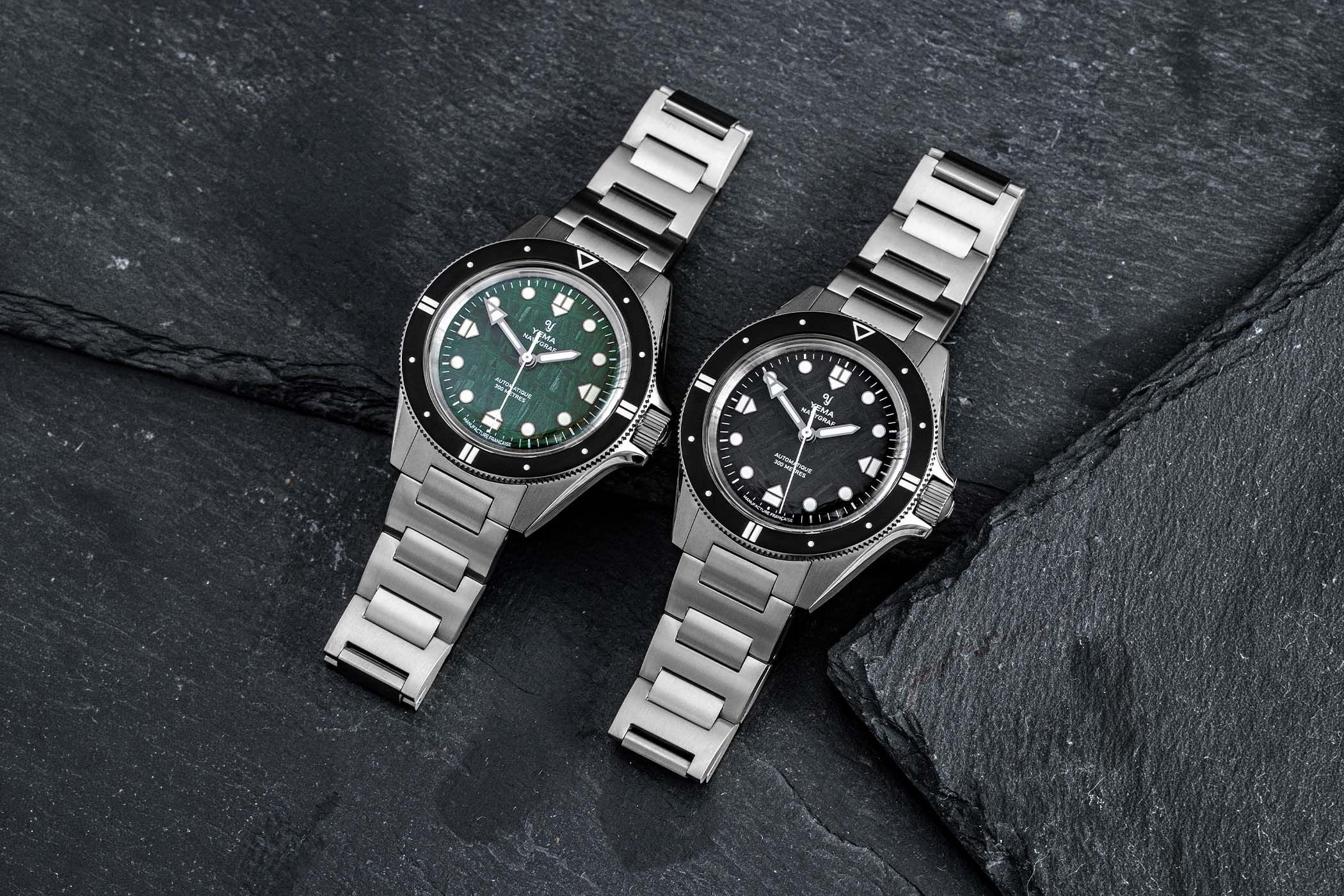
Yema gives the Navygraf a distinctive dial material with black and green interpretations of Muonionalusta meteorite. The naturally occurring Widmanstätten pattern provides a different surface on each watch, surrounded by a 39mm titanium case with brushed finishing and polished bevels. Inside, the automatic CMM.10 movement offers a 70-hour power reserve and a stated daily accuracy range of –3 to +5 seconds. The specifications include 300-meter water resistance, a double-domed sapphire crystal, luminous hands and markers, and a titanium bracelet with micro-adjustment. Individually numbered limited production adds another collecting element to a watch whose strongest distinction is already visible on its face. Price: approximately US$3,300, converted from €2,900.
Reviews
An US$850 Tourbillon: Mechanical Entertainment With Ownership Questions
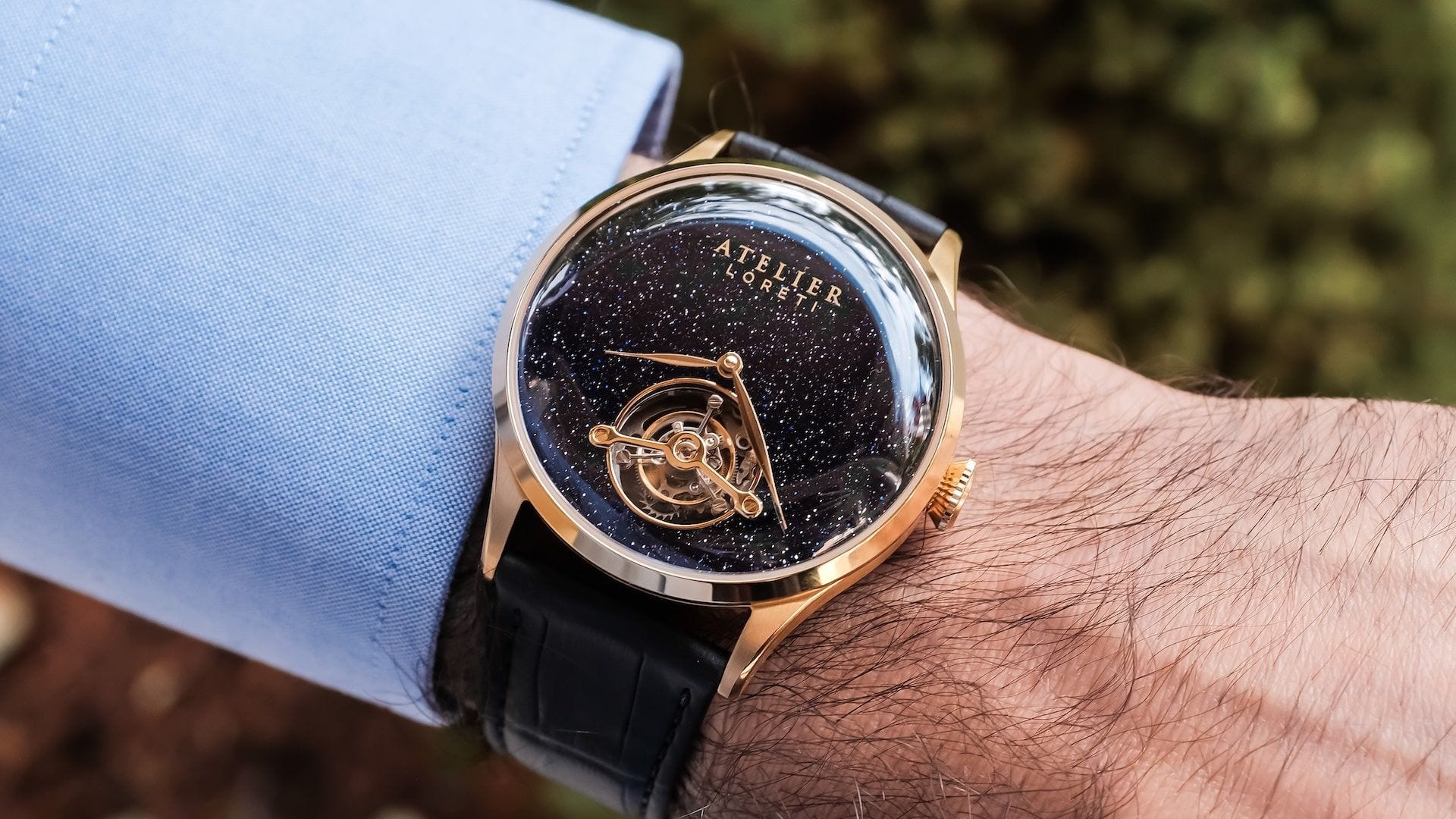
The Atelier Loreti Celestial Tourbillon poses an irresistible question for mechanically curious collectors: what happens when a complication associated with expensive watchmaking becomes available for US$850? Its gold-tone case and aventurine dial create a suitably theatrical setting, and the review finds real entertainment in the mechanism itself.
The compromises become clearer when the watch is judged as a complete product. Legibility, strap quality and power reserve receive criticism, while the longer-term availability of service remains an important uncertainty. The review’s value is in separating the pleasure of seeing a tourbillon operate from the broader demands of owning and wearing the watch around it.
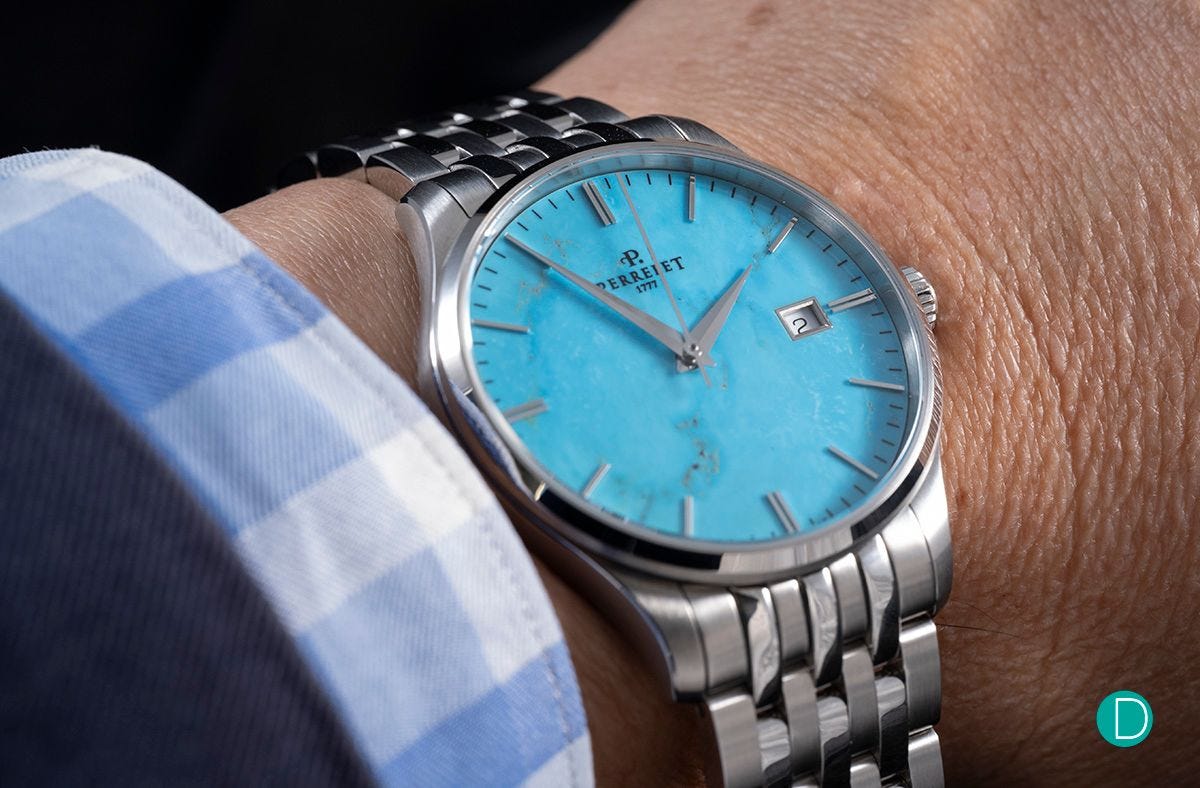
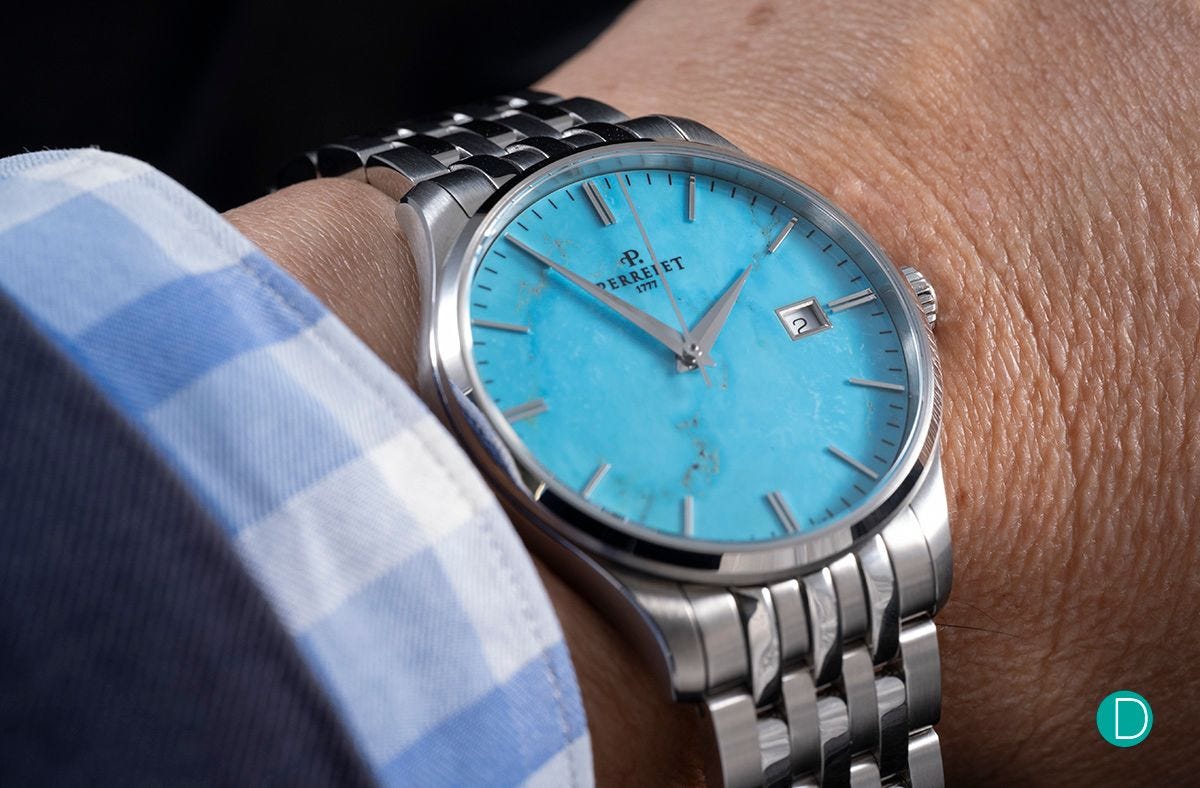
Perrelet Weekend Stone Dials Put Natural Materials at the Center
Perrelet expands the Weekend collection with turquoise, lapis lazuli, tiger’s eye and black onyx dials. A restrained 39mm stainless-steel case keeps attention on the stone, while applied markers, dauphine hands and a date window provide a conventional framework around the individual patterns and colors. The automatic Soprod-made P-321 movement delivers approximately 42 hours of power reserve.
The review considers how successfully that combination balances visual character with everyday usefulness. There is no lume, but the metallic hands and markers provide contrast in daylight, and strap or bracelet choices alter the watch’s personality. At CHF1,590—approximately US$1,910—the collection gives buyers a comparatively accessible way to explore natural-stone dials in a Swiss-made automatic.
Events
New York’s October Watch Calendar Comes Together
WatchTime and Windup are aligning on October 16–18, creating an unofficial New York Watch Week with markedly different but complementary experiences. WatchTime’s ticketed event at Gotham Hall brings together a curated group of luxury watchmakers, while Worn & Wound’s Windup offers free admission at Center415 and a much larger roster spanning independent and accessible brands. The venues are close enough to make visiting both a practical proposition.
Indies.NYC adds an October 15 evening gathering focused on independent watchmaking and direct conversation. Together, the events offer collectors a chance to handle watches that are otherwise experienced mainly through photographs and specifications. The concentrated schedule also encourages exploration across price categories, with established names and smaller makers sharing the city’s attention.
Podcasts
From the Archives: The Business of Watches—La Joux-Perret CEO Jean-Claude Eggen
This March 25, 2026 episode of Hodinkee’s The Business of Watches provides a useful companion to today’s manufacture feature. Host Andy Hoffman speaks with La Joux-Perret CEO Jean-Claude Eggen about movement production, pricing, technology and the business of supplying brands with very different requirements. The conversation examines the company’s growth to approximately 200,000 movements annually and its ambitions for greater precision and smaller calibers.
The episode also introduces Tad Kozh, an initiative supporting the development of specialist skills among young watchmakers. Together, the discussions connect the economics of production with the people needed to sustain watchmaking’s more demanding crafts.
Videos

Britt Pearce: Omega Quietly Discontinued Hundreds of Watches
Britt Pearce examines a substantial reduction in Omega’s catalog and what it means for enthusiasts navigating the brand’s many collections and variations. The subject raises questions about how a major manufacturer balances breadth, recognizable product families and the need to keep its offering manageable. For collectors, the discussion provides a starting point for thinking about discontinued references and changing availability, without assuming that removal from a catalog automatically makes a watch more desirable.

The Iced Coffee Hour Clips: Building a Watch Collection Under US$15,000
A fixed collection budget forces decisions that a single-watch wish list can avoid. This discussion considers how to distribute US$15,000 across a selection of watches, balancing recognizable names, different uses and the desire for quality. The interesting question is how the pieces work together: a satisfying collection should give its owner reasons to wear each watch, rather than simply accumulate variations on the same purchase.
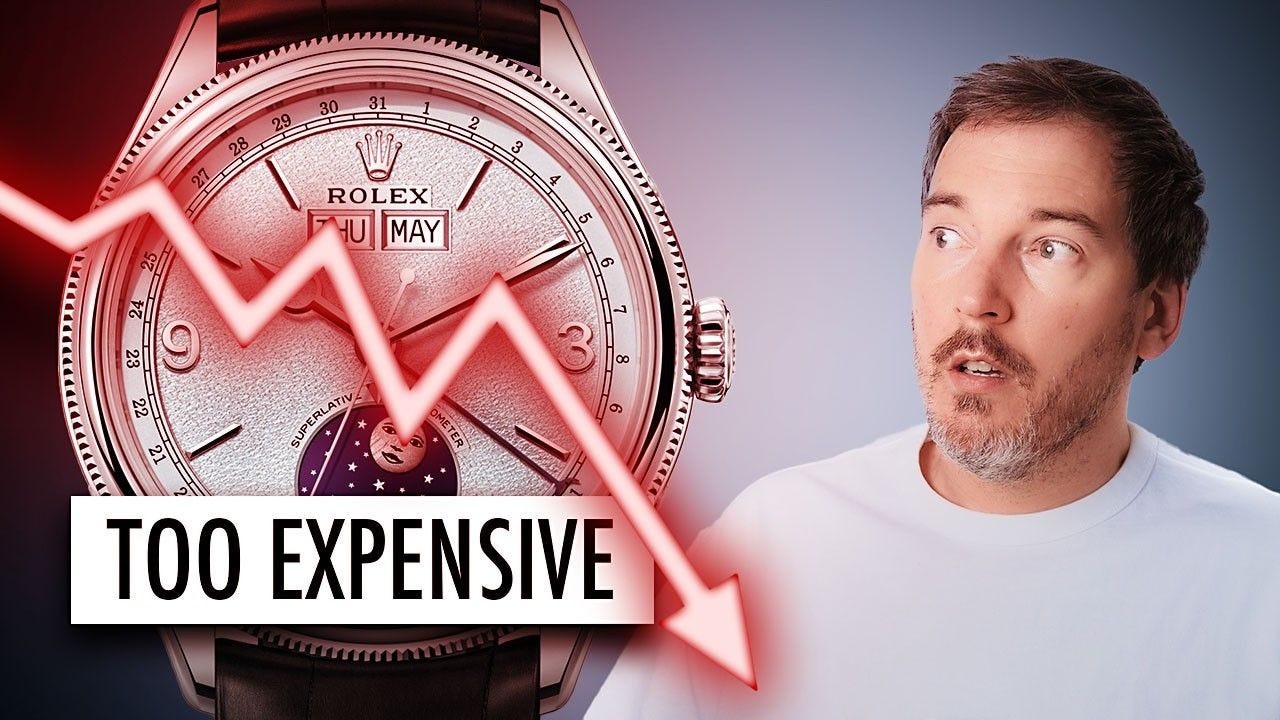
Andrew Morgan Watches: “The Decline of Rolex”
Andrew Morgan uses a provocative title to examine Rolex’s position within a changing watch market. The discussion considers the relationship between collector demand, status and the alternatives competing for buyers’ attention. It is best approached as a market argument to examine, with the distinction between changes in enthusiasm, secondary-market pricing and the underlying strength of a watch business kept firmly in view.
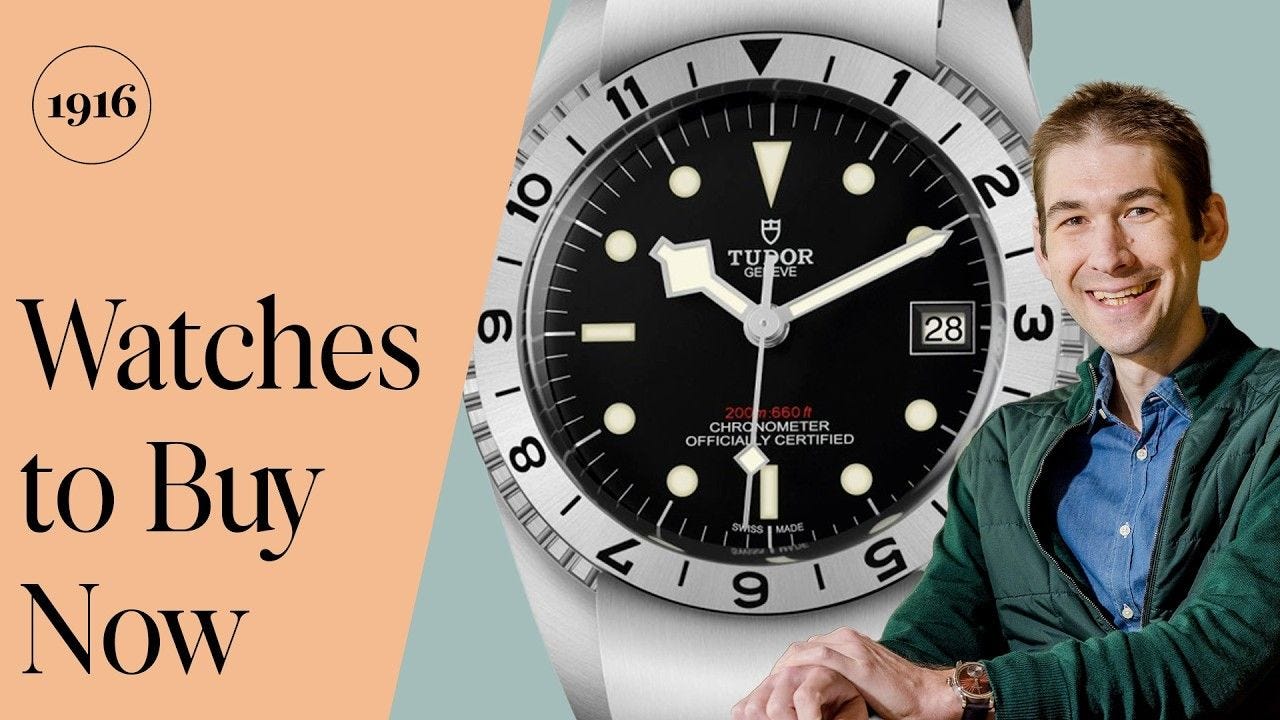
The 1916 Company: Five Watches to Consider Right Now
The 1916 Company presents a five-watch selection built around the appeal of individual models in the current market. Design, construction and collecting interest provide the basis for comparing watches that may serve different tastes and purposes. As with any dealer-led selection, the useful exercise is to understand the reasoning behind each choice and decide which characteristics matter in your own collection.

Time+Tide Takes Cartier Enthusiasts Inside the Melbourne Boutique
Time+Tide brings passionate Cartier collectors to the brand’s Melbourne boutique to experience watches in person and compare expectations with what happens on the wrist. The premise is simple: which watch did each visitor most want to see, and which one ultimately captured their attention? Their reactions underline how strongly proportions, surface finishes and the movement of light can change an impression formed from photographs. This is a collector gathering and hands-on encounter with Cartier’s watches, with the pleasure of discovery at its center.
Auctions
Four Unique Rolex Daytonas Bring a Reported US$49.4 Million for Charity
The Rolex Four Seasons Daytona collection reportedly achieved a combined US$49.4 million at its London charity auction. The four unique watches interpret winter, autumn, spring and summer through different precious metals and elaborate gemstone treatments, with proceeds benefiting the Federer Foundation and Re. Phillips and Aurel Bacs conducted the sale, bringing together exceptional watches and a philanthropic setting capable of producing exceptional bidding.
The result deserves to be understood in that context. Unique pieces created for a prominent charity event occupy a different market from ordinary production references, where buyers compare condition, availability and established transaction histories. The sale demonstrates the fundraising power of Rolex’s reputation and these particular watches, while offering limited guidance for valuing a standard Daytona.
Auction Results
US$117,500 Wasn’t Enough: F.P. Journe Élégante Remains Unsold
The September 28 featured auction for the 2018 F.P. Journe Élégante 48 in titanium ended without a sale. The white-dial watch attracted a high bid of US$117,500, but that figure did not satisfy the seller’s reserve.
The reserve amount was not supplied, so the gap between the bidding and the seller’s expectations cannot be calculated. What is clear is that even a six-figure bid could not complete the transaction. The result records a serious expression of interest in this example, alongside a seller who wanted more; it is not a completed sale at US$117,500.
Auction Report
Seven Days of Mechanical Theater: Bovet’s Rose-Gold Récital 0 Faces the Market
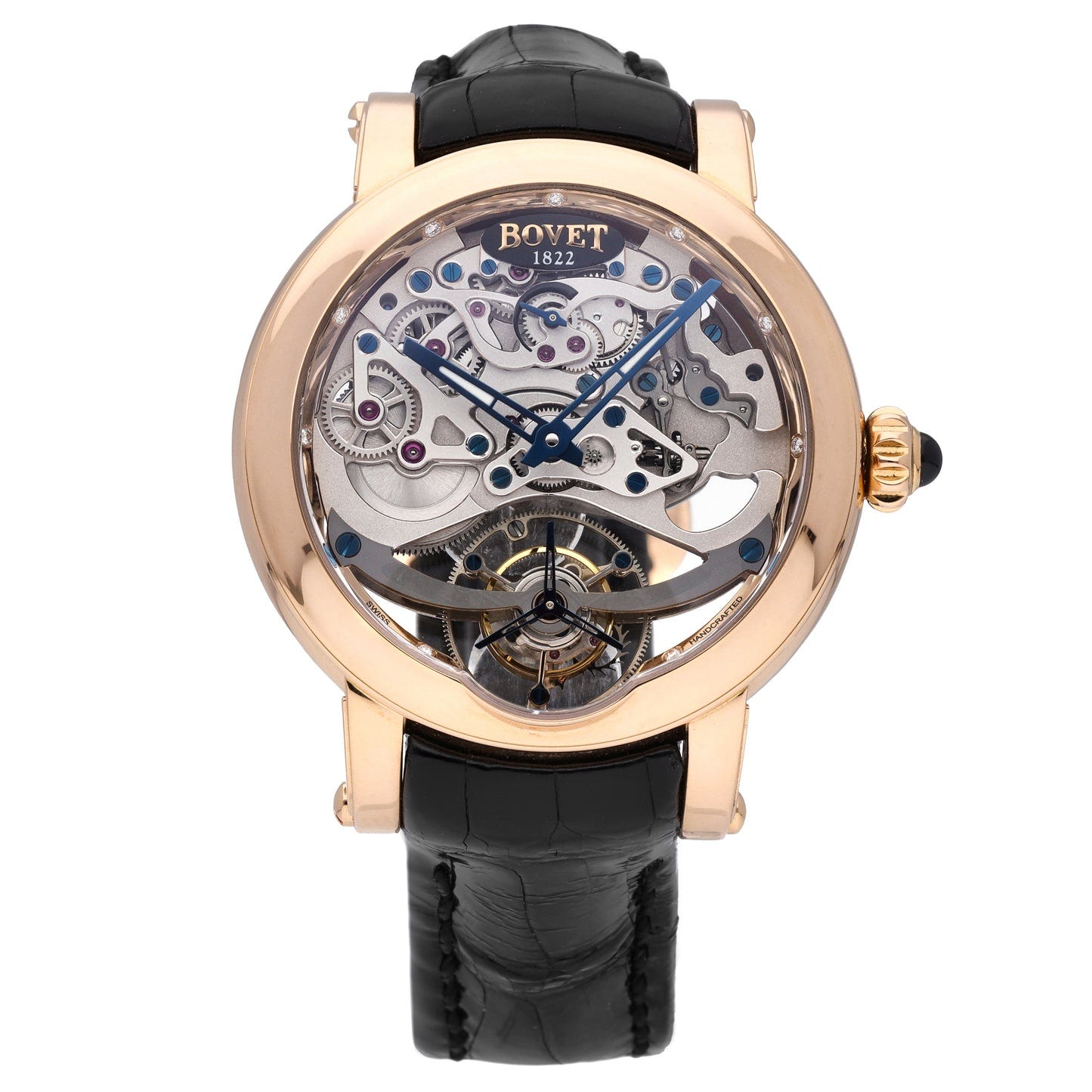
Today’s featured auction brings a Bovet Dimier Récital 0 tourbillon, reference R041003, to the block in a 41mm rose-gold case with an openworked display. The model belongs to Bovet’s modern revival under Pascal Raffy, who acquired the house in 2001 and expanded its manufacturing capabilities through the Dimier acquisition in 2006. The Récital 0 family was introduced in 2011, building on the early Récital collection’s emphasis on tourbillon watchmaking. Its conventional crown placement and wristwatch proportions give it a different character from Bovet’s pocket-watch-inspired Fleurier designs.
The manually wound movement offers a seven-day power reserve, with the tourbillon and exposed architecture providing the visual attraction. Hours, minutes, seconds and a power-reserve indication turn the openworked construction into a functional display rather than decoration alone. At 41mm, the watch presents substantial mechanical detail within dimensions that are relatively restrained for this kind of complicated showpiece. Its appeal depends on the relationship between the warm rose-gold case and the machinery visible within it.
The U.S.-located auction example comes with box and papers and is described as a store display piece, although the overall condition category is pre-owned. The supplied report rates the dial and strap or bracelet category as excellent; its general wording allows for possible servicing or polishing without establishing that either occurred. The listing’s “2017–present” year range does not identify this particular watch’s production date. Confirmation of its date, service history and current mechanical performance would therefore help establish how it compares with other examples.
For value context, an exact-reference R041003 dealer listing is advertised at US$84,950 with box and papers and a like-new or unworn description. That is an asking price, not a verified transaction, and it does not establish the auction watch’s realizable value. No sufficiently comparable completed sale was verified to justify a firm auction estimate; bidders should weigh the individual watch’s condition and service needs alongside the total acquisition cost. The attraction is significant watchmaking in precious metal, but the price must stand on more than an advertised comparison. The auction ends at 1:40 p.m. EDT on Tuesday, September 29, 2026.
Current bid: $750.00
Losing Time


Today’s Big Losers at Auction on Grailzee
The four failed sales offered a useful reminder: sellers set the asking prices, but bidders are under no obligation to admire the imagination behind them.
The Arnold & Son DSTB DBG Equation GMT, 44mm, asked $15,220 and drew a final bid of $4,600—a $10,620 shortfall, or 69.8% below ask. That is less a narrow negotiating gap than two people attending entirely different auctions. The watch may offer mechanical complexity, but the bidding delivered a simple answer: nowhere near that price.
The 2025 Konstantin Chaykin Ace of Hearts x Behrens “Joker” limited edition, 37mm, attracted $5,600 against a $9,490 ask, missing by $3,890, or 41.0%. The Joker produced the closest approach to its asking price of these four listings, which is rather like winning a high-jump competition by hitting the bar least badly. The collaboration and limited-edition billing drew interest, but bidders declined to fund the full punch line.
The H. Moser & Cie Endeavour Centre Seconds, 41mm, carried a $15,000 ask and reached $8,000, leaving a $7,000 gap, or 46.7% below ask. Understated elegance apparently extended to the bidding. There was an audience for the watch at $8,000; the additional $7,000 remained a seller-side aspiration.
The 2026 Audemars Piguet Royal Pop “Swatch OTG ROZ,” 40mm, asked $2,000 and received a high bid of $750—$1,250 short, or 62.5% below ask. The turquoise dial supplied the color; the seller supplied the optimism. Whatever premium the asking price anticipated, this auction’s bidders were prepared to recognize only a fraction of it.
Together, the four listings sought $41,710 and attracted combined final bids of $18,950, a 54.6% aggregate shortfall. The common thread is a substantial mismatch between seller expectations and what these bidders would pay. Every watch missed by at least 41%, so these were hardly deals derailed by the last few dollars. Four unsuccessful auctions cannot establish the entire market’s value, but they can deliver a fairly coherent message: rarity, complications, and branding may earn attention; they do not automatically earn the asking price.
Closing Time
Thank you for spending part of your day with BuyingTime. Today’s issue offers plenty to admire, from a compact vintage Rolex to a tourbillon that puts its engineering on full display. Keep looking closely, leave room for an unexpected favorite, and remember that enjoying a watch and agreeing with its price are separate decisions. We’ll be back tomorrow with more watches, more stories and another look at what the market is telling us.