

30 Second Read
Today’s issue is about access—and the many ways it is changing the watch world. Hublot has created a new point of entry for Chicago collectors, while Indies NYC is investing directly in the future makers who will keep independent watchmaking alive. Windup and Time at Wynn show that collecting is increasingly built around shared experiences, not just transactions. On the product side, Omega and Longines are making familiar icons and complications more approachable, while today’s auction watch, the Breguet Messidor, reminds us that certain watches still demand patience, study, and a very clear sense of market value.
Time Graphing Today’s Watch Universe
The most interesting movement in watches right now is not a new bezel color or another limited edition. It is the widening definition of access. Access used to mean getting allocated a hard-to-find steel sports watch. Today it can mean having a place to see a brand in person, an invitation to sit with an independent maker, a fair that is free to enter, or a watch that lets a collector participate in an idea without needing an insider’s handshake.
That is why Hublot’s first Chicago boutique matters beyond its 844 square feet. The real product is a physical relationship with the brand in a city that has never lacked collectors, only enough places to handle the watches. The same is true, in a more intimate and arguably more consequential way, of Indies NYC’s new educational initiative. A percentage directed toward watchmaking schools is an investment in the next generation of makers—and, eventually, in the originality collectors say they want.
The calendar offers its own evidence. Time at Wynn turns a resort into a collector destination, while Windup Watch Fair NYC makes discovery available at scale. And the product stories are converging on the same point: Omega is making the Speedmaster easier to wear with its new 38 mm family; Longines is making serious complications feel unusually attainable; and the independent end of the market is still asking collectors to work for it, whether the prize is an F.P. Journe or a painstakingly hand-engraved Royter Nova.
The tension is healthy. Watches need aspiration, connoisseurship, and a little difficulty. But the strongest brands understand that a community cannot live on scarcity alone. It needs entry points: a boutique, a fair, a conversation, a good first mechanical watch, and a reason to keep learning after the first purchase. The companies and collectors expanding those entry points are doing more than selling watches. They are building the next audience for them.
-Michael Wolf
NEWS
Hublot Opens Its First Chicago Boutique—Fulton Market Gets Its Porthole
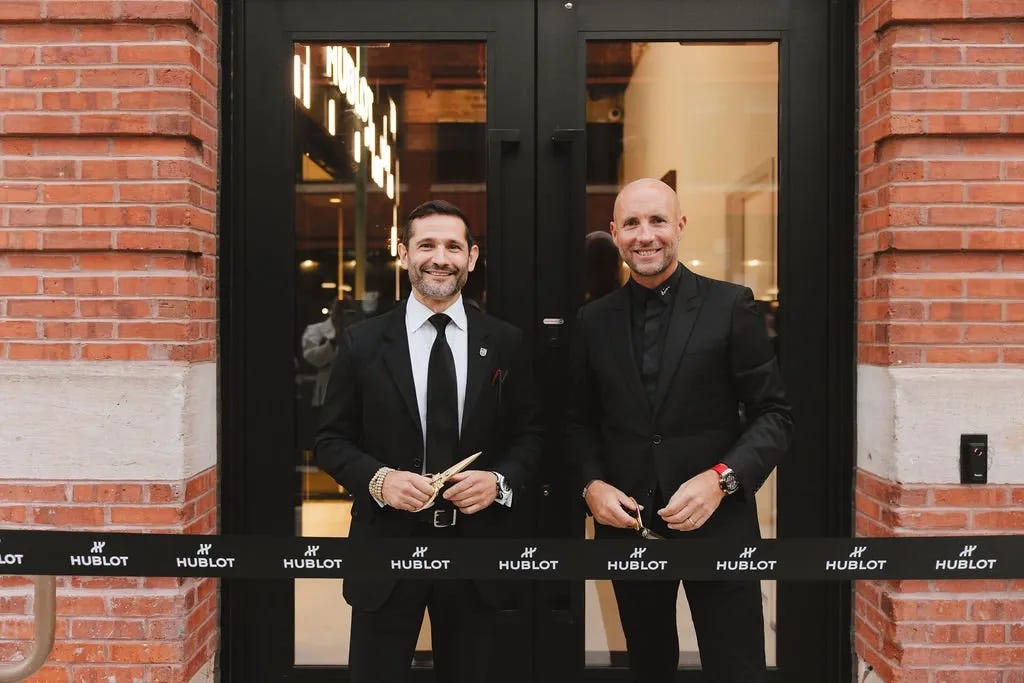
Hublot has opened its first Chicago boutique at 1133 W. Fulton Market, its sixteenth U.S. location and twentieth in North America. The 844-square-foot space brings the Big Bang, Spirit of Big Bang, Classic Fusion, complications, and high-jewelry collections closer to Midwestern collectors, in a setting that pairs preserved brickwork with Hublot’s familiar black, steel, and porthole-inspired codes. It is a smart retail move in a city whose watch audience has long been deeper than its brand footprint.
The boutique also gives visitors a practical reason to stop in: Hublot’s updated warranty now begins at five years and can be extended to ten through the Hublista loyalty program.
Indies NYC Is Getting Charitable with a New Initiative Supporting Watchmaking Schools
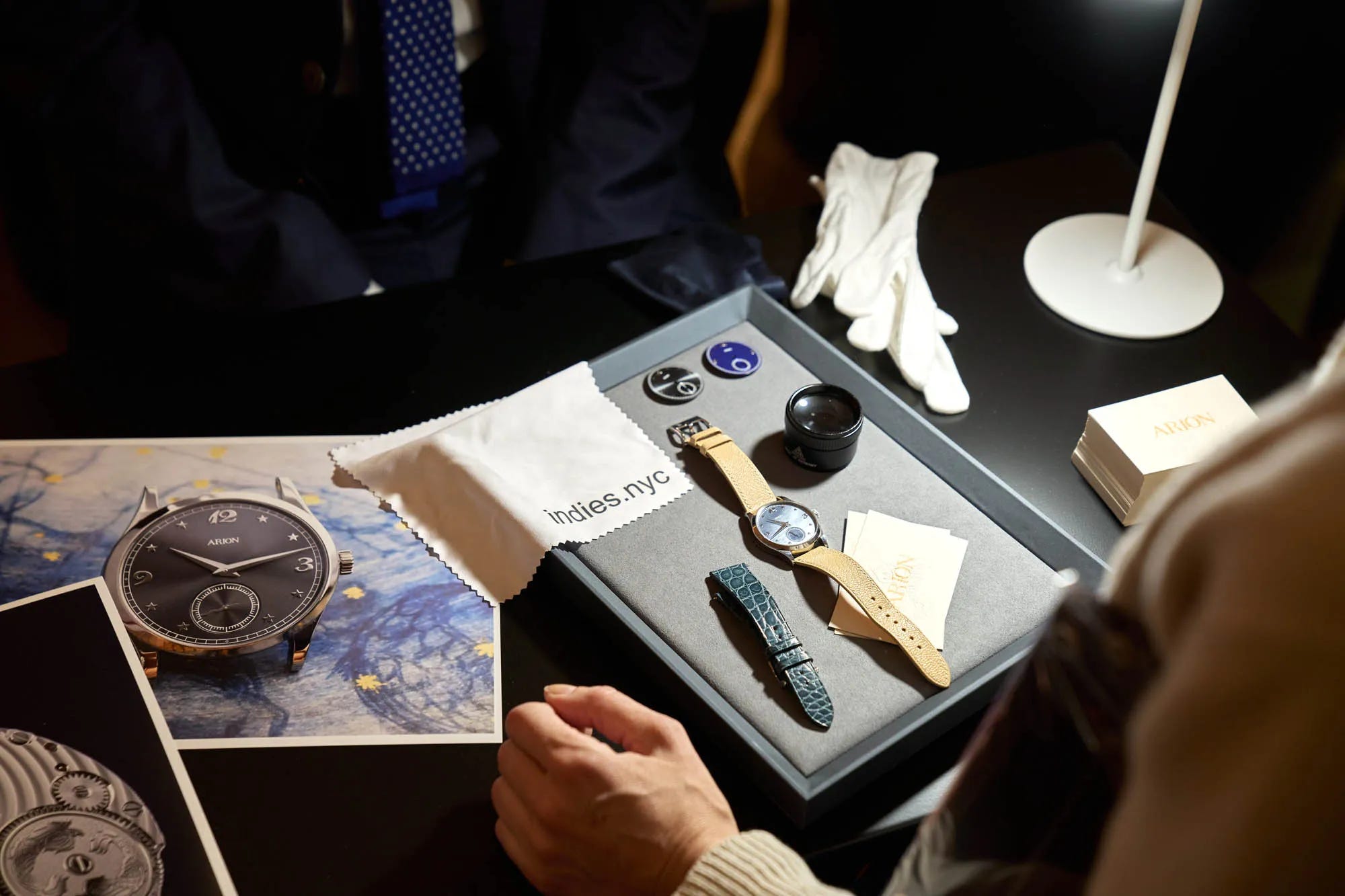
Indies NYC has always taken a more collector-first approach than a conventional watch fair. Founded by Jon Cruys, the invitation-only salon gives independent makers room to meet collectors without asking them to buy exhibition space. Its October 15 edition will feature twenty brands, but the bigger news is the launch of “1% for the Next Generation,” a new program supporting watchmaking education.
It is a modest idea with real long-term relevance. Independent watchmaking depends on a steady flow of technically capable young makers, and a community that wants more original watches should be willing to help cultivate the people capable of creating them.
Norqain Makes Baseball History with Lawrence Butler
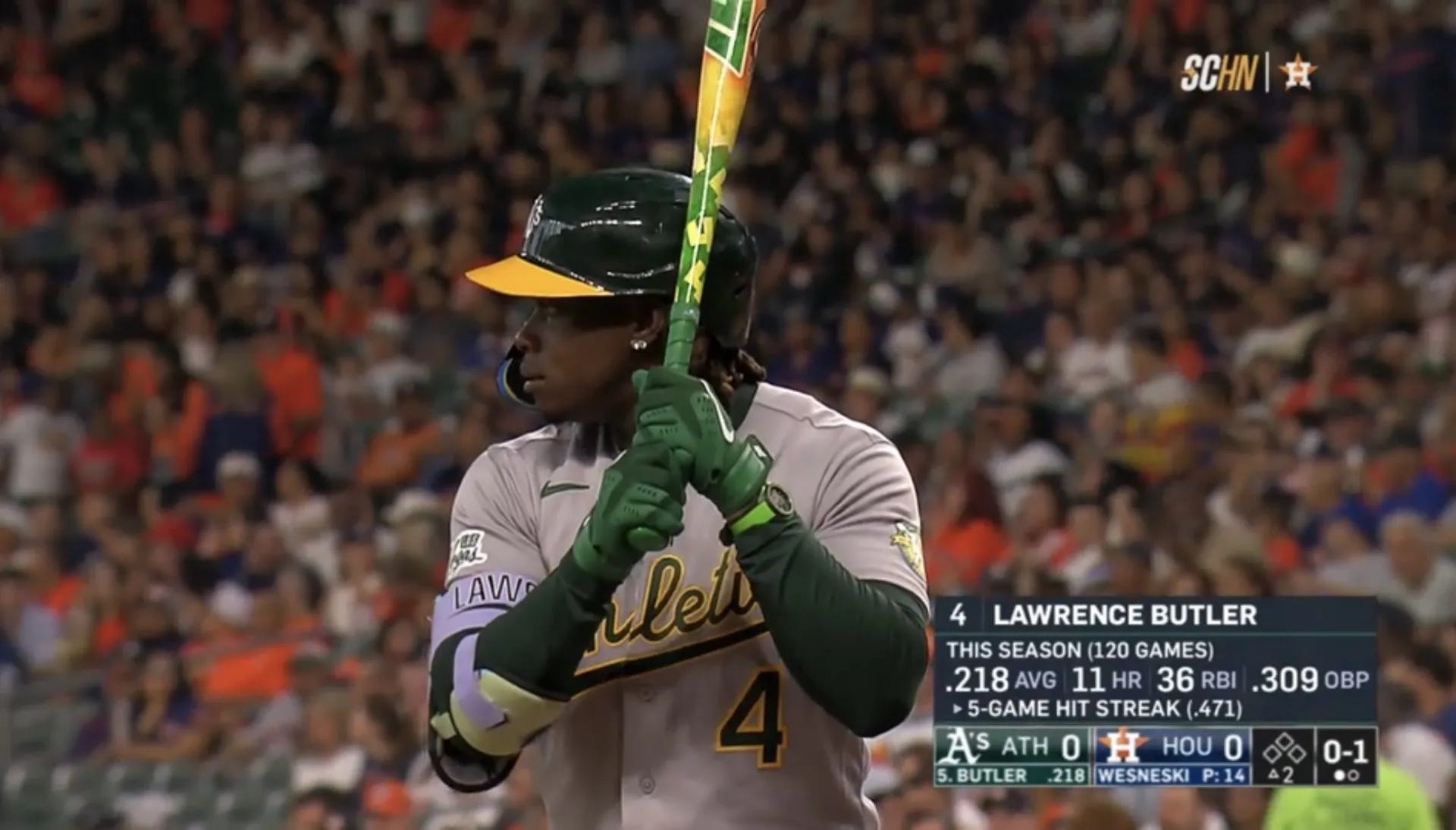
Lawrence Butler became the first known Major League Baseball player to wear a mechanical watch during an official game, taking the field in Norqain’s Wild ONE Skeleton Gecko. At 78 grams and rated to withstand impacts up to 5,000 g, the carbon-composite watch is among the few mechanical pieces with a credible case for surviving professional sport.
The game-worn watch, originally introduced in 2024 and valued at $6,790, will be auctioned by MLB for charity. It is a memorable bit of product placement because it happened in the setting that actually tests the premise.
FEATURES
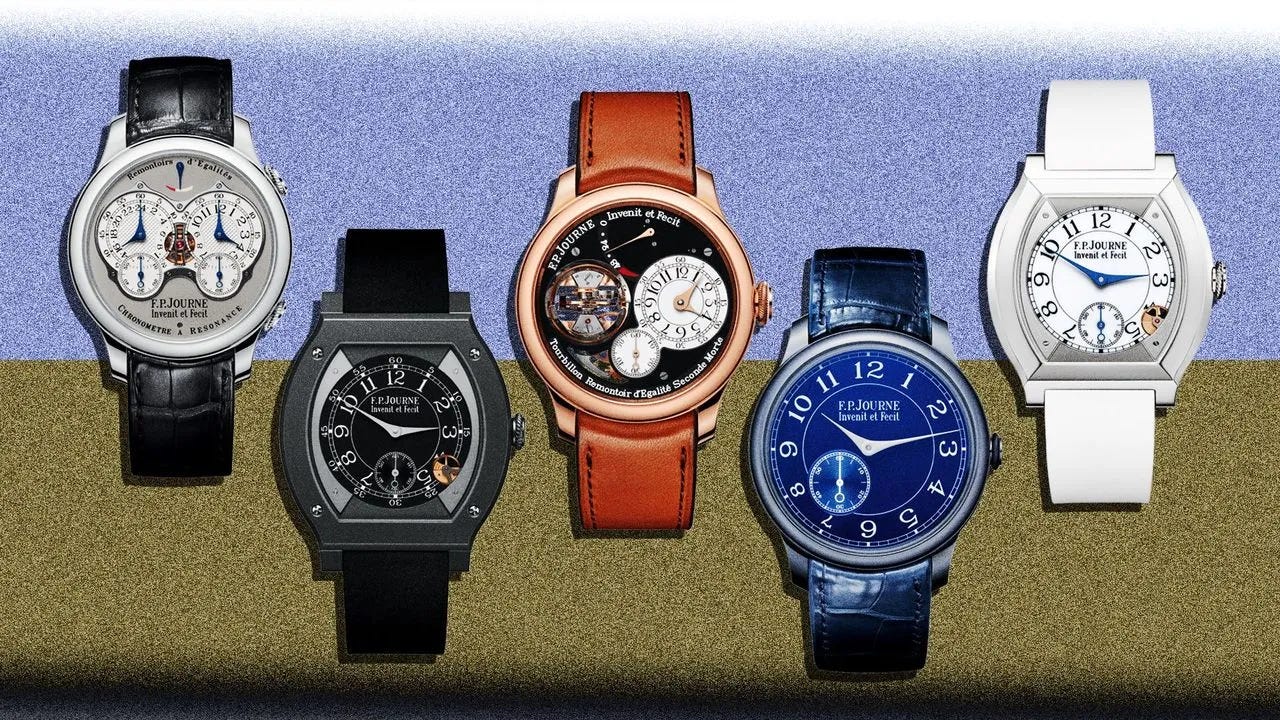
Everyone Is Going Crazy for This Swiss Indie Watchmaker
F.P. Journe remains the modern independent watchmaker collectors cannot stop talking about, even as the brand works hard to remain difficult to obtain. Founded in 1999, the manufacture produces only a handful of watches per day, with François-Paul Journe’s design and technical fingerprints visible across the collection.
Chanel’s 2018 investment and the pandemic-era surge in luxury watches heightened awareness, but the appeal is not merely scarcity. The Chronomètre Bleu, Élégante, and Chronomètre à Résonance all feel like watches with a point of view. For collectors, that coherence remains one of the rarest luxuries.
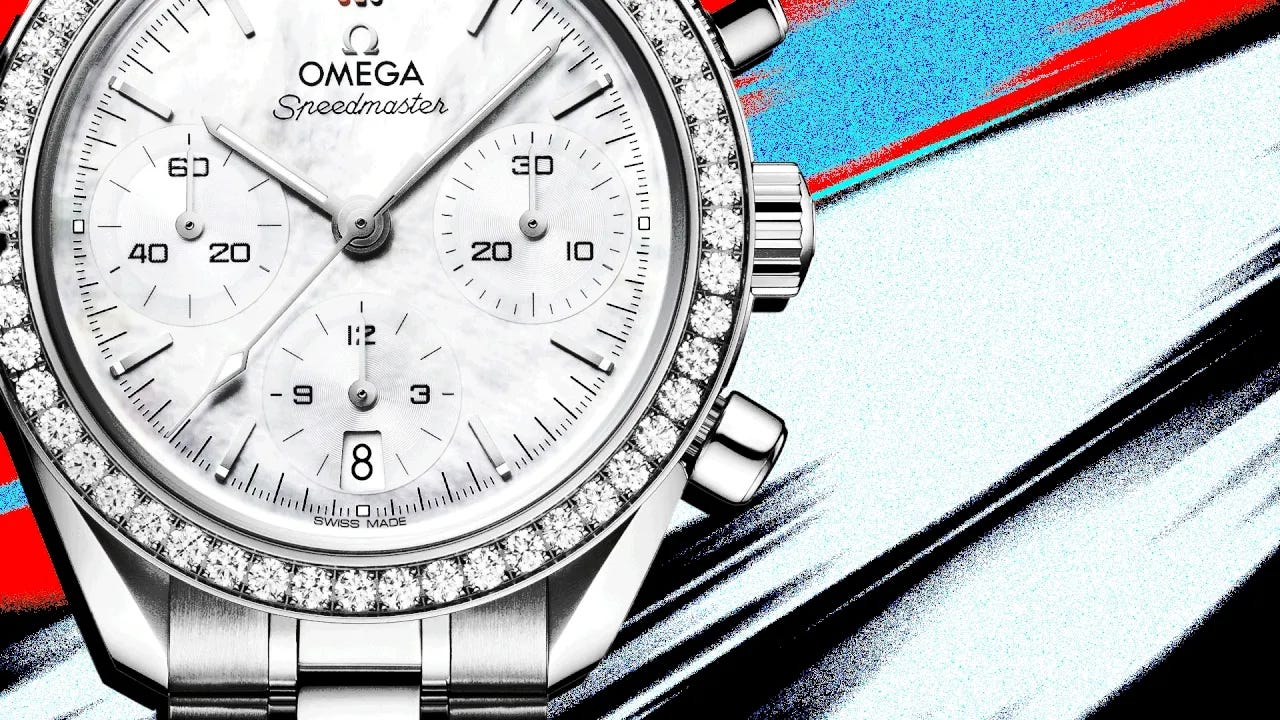
Happy New Omega Speedmaster Day to All Who Celebrate
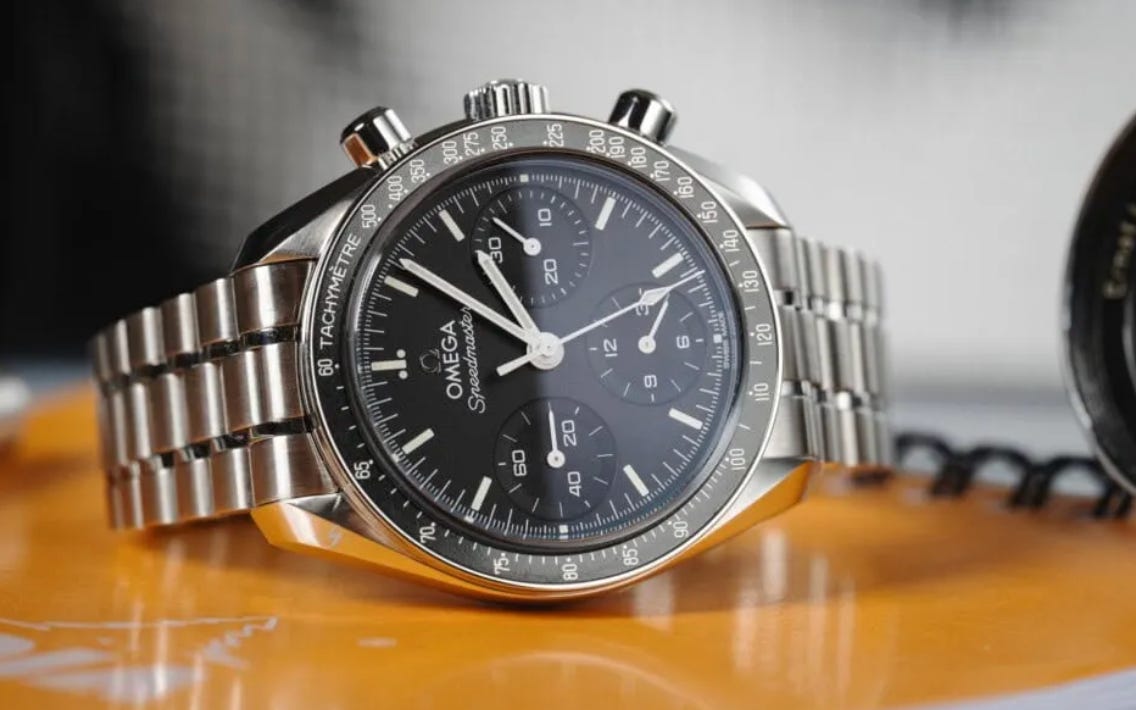
Omega’s refreshed Speedmaster 38 collection shows how much life remains in a very familiar formula. Seven colorways, from restrained black and blue to ice-blue and mother-of-pearl diamond executions, bring a brighter and more wearable energy to the Speedmaster’s compact line.
The 38 mm format will not replace the Moonwatch, nor should it. But it offers a different route into the Speedmaster story: automatic, contemporary, and more accommodating for collectors who find the Professional a little too much watch.
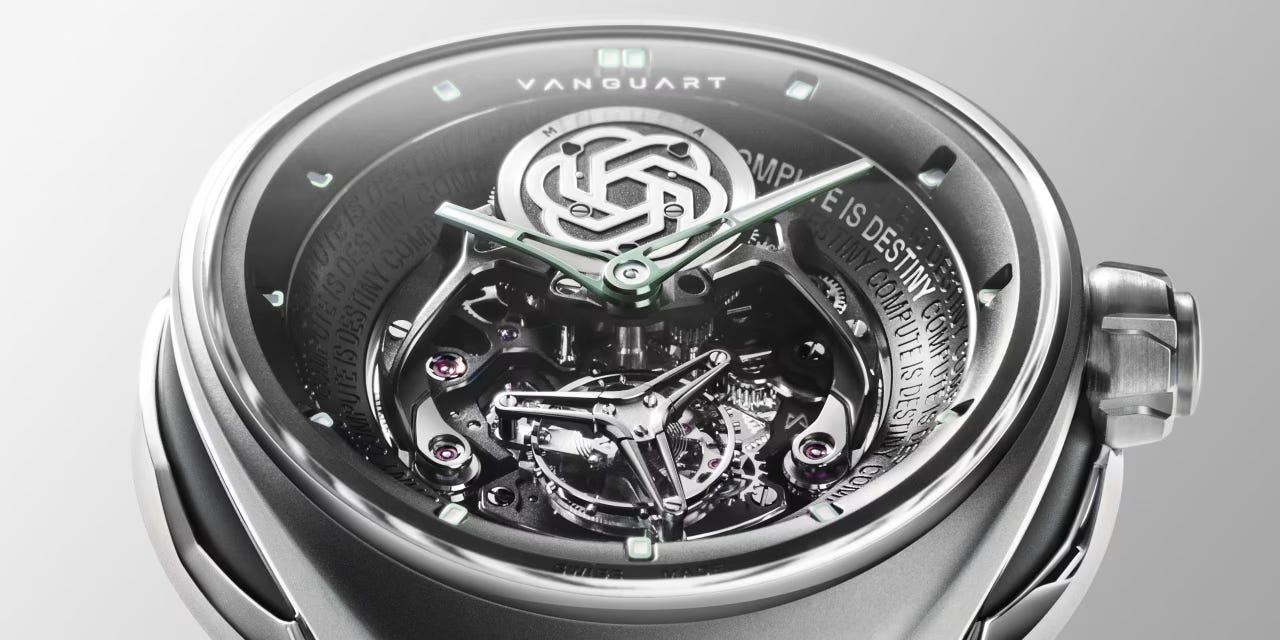
Silicon Valley’s Newest Status Symbol Is a Super-Rare Sam Altman Swiss Watch
For technology’s top tier, a custom watch is becoming a more tactile kind of calling card. Vanguart’s bespoke pieces for Silicon Valley insiders reportedly combine titanium cases, highly personal engraving, and a level of scarcity that makes them closer to corporate artifacts than ordinary luxury goods.
The larger story is about how people whose work is mostly digital still seek physical proof of belonging. In a world of code, compute, and intangible value, a hand-finished Swiss watch is an unusually direct way to make status visible.
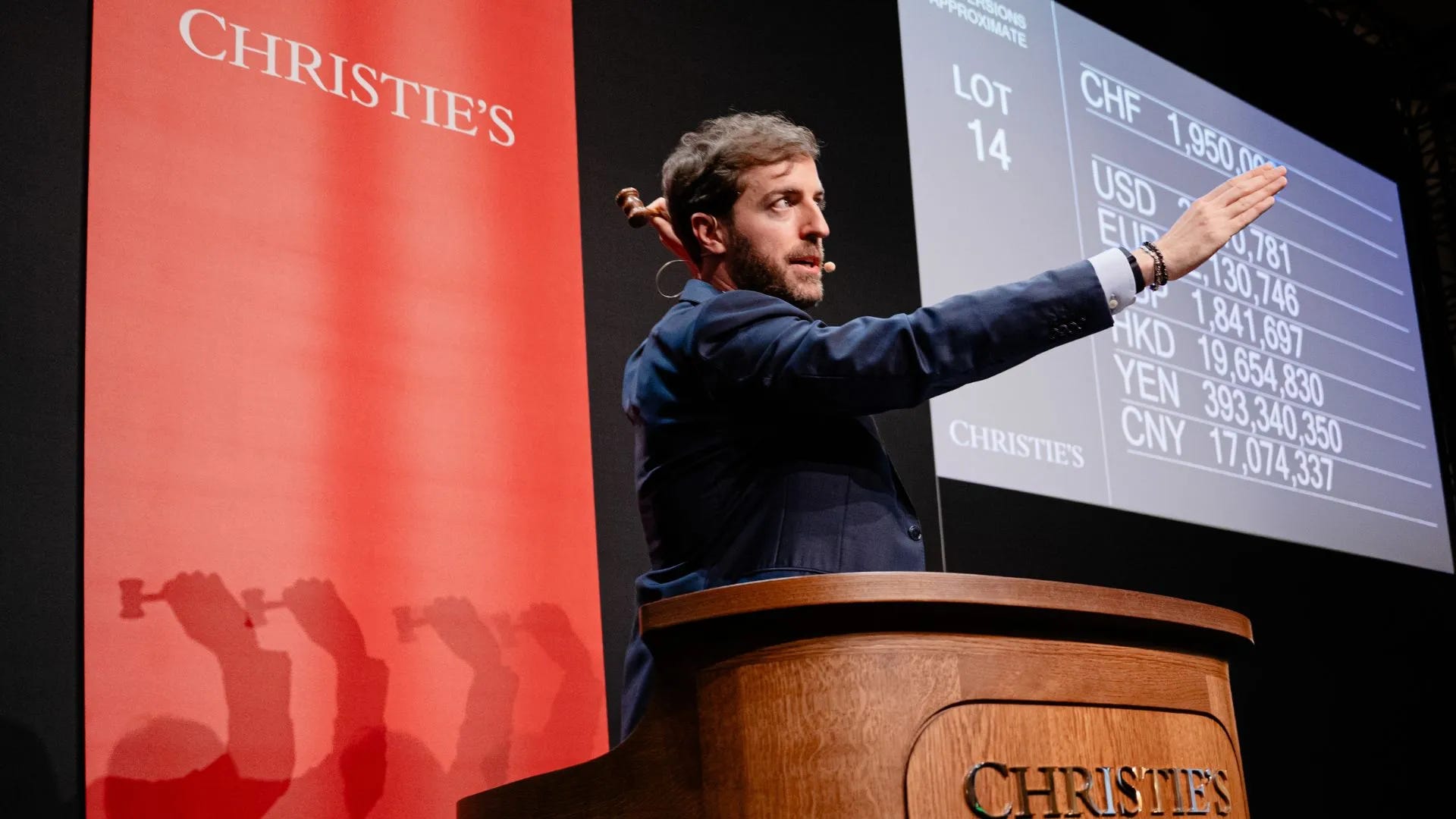
Christie’s Rémi Guillemin on the New Era of Watch Collecting
The next generation of collectors is less interested in assembling a predictable list of logos and more interested in watches with relevance, condition, rarity, and a story worth telling. Christie’s Rémi Guillemin sees a market becoming more discerning rather than simply more speculative.
That shift favors collectors willing to research provenance, understand original condition, and build a collection with a personal through-line. It also favors brands that speak honestly with their communities instead of treating the secondary market as someone else’s problem.
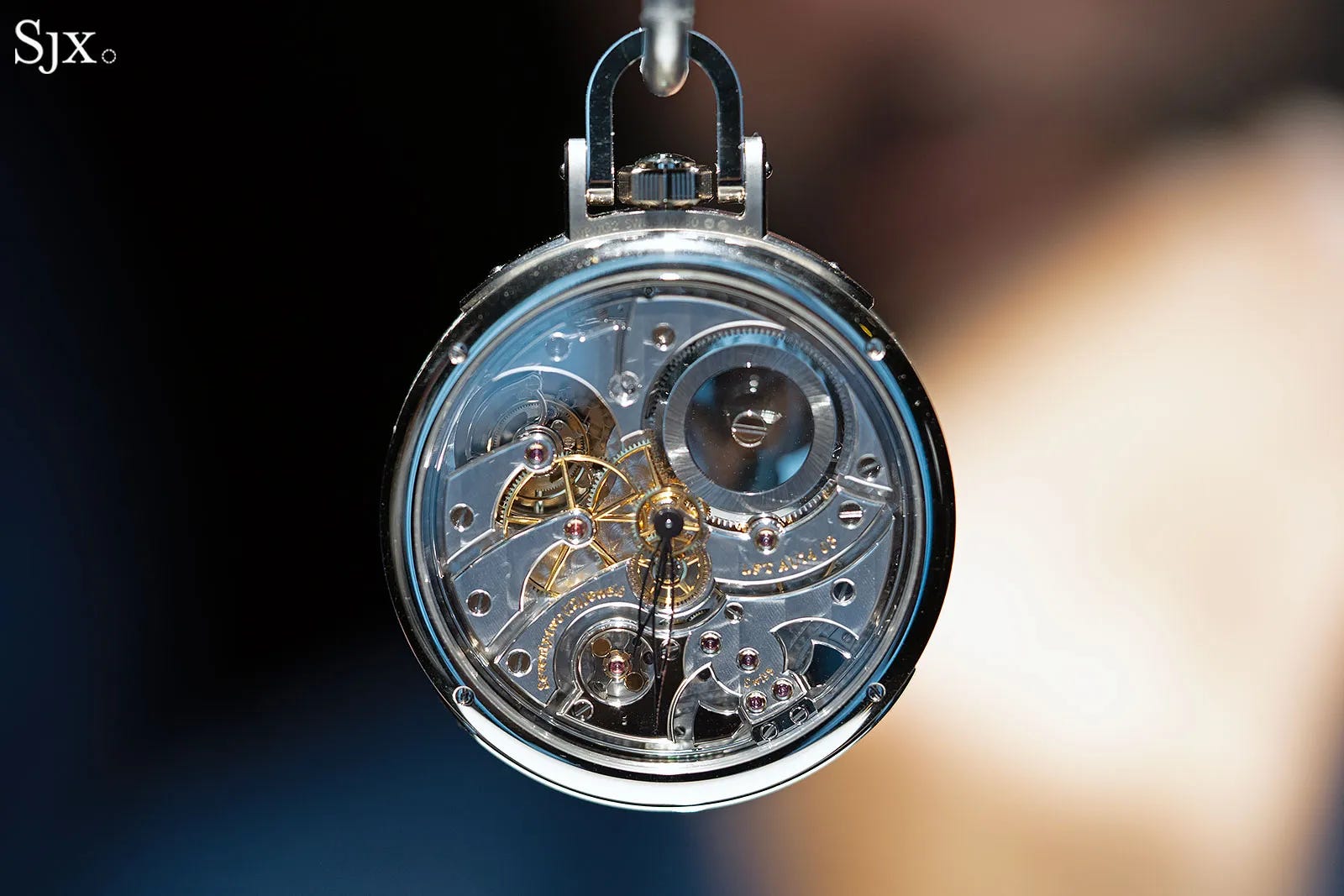
Why Is Everything Inverted?
Inverted movements are becoming one of modern watchmaking’s most recognizable visual languages. By moving the mechanics to the dial side, brands turn the gear train, barrel, and escapement into the main attraction—and make every wrist shot more dramatic.
The trend makes sense in an image-driven collecting culture, but it creates a trade-off. An exposed movement can be an extraordinary object, yet it removes the dial from the equation. The best examples understand that finishing and architecture must now do the work that a great dial once did.
NEW WATCHES
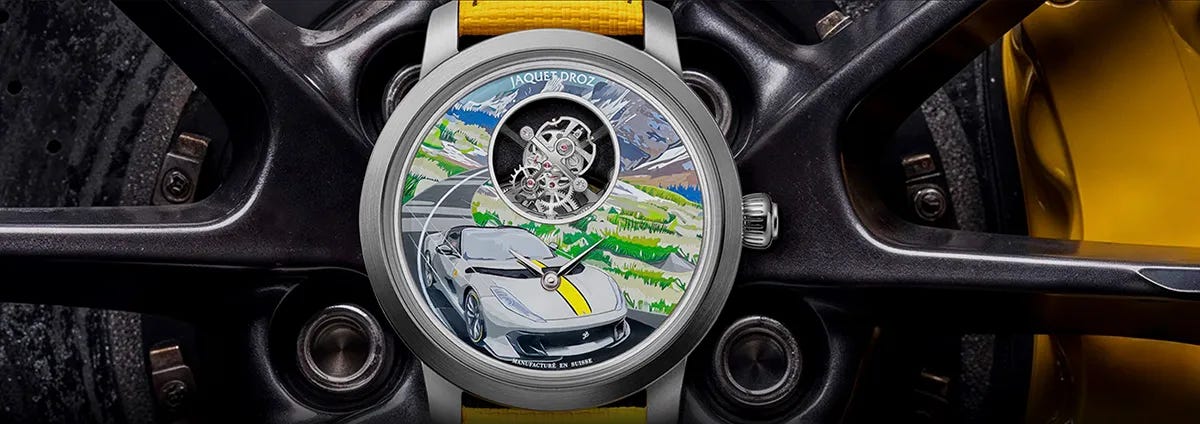
Jaquet Droz Tourbillon Plasma Ceramic: A New Piece Unique with Price, Specs and Details
Jaquet Droz’s Tourbillon Plasma Ceramic Oberalp is a one-off built around a private collector’s Ferrari V12 and a love of the Alpine Oberalp Pass. Its sapphire dial carries a hand-painted miniature of the car, while its white-gold rotor echoes the owner’s wheel design.
The 42.3 mm plasma-ceramic case houses the self-winding skeletonized Jaquet Droz 2625SQ tourbillon movement, with an eight-day power reserve. This is bespoke watchmaking at its most literal: a complicated machine designed to hold a very specific owner’s memory.
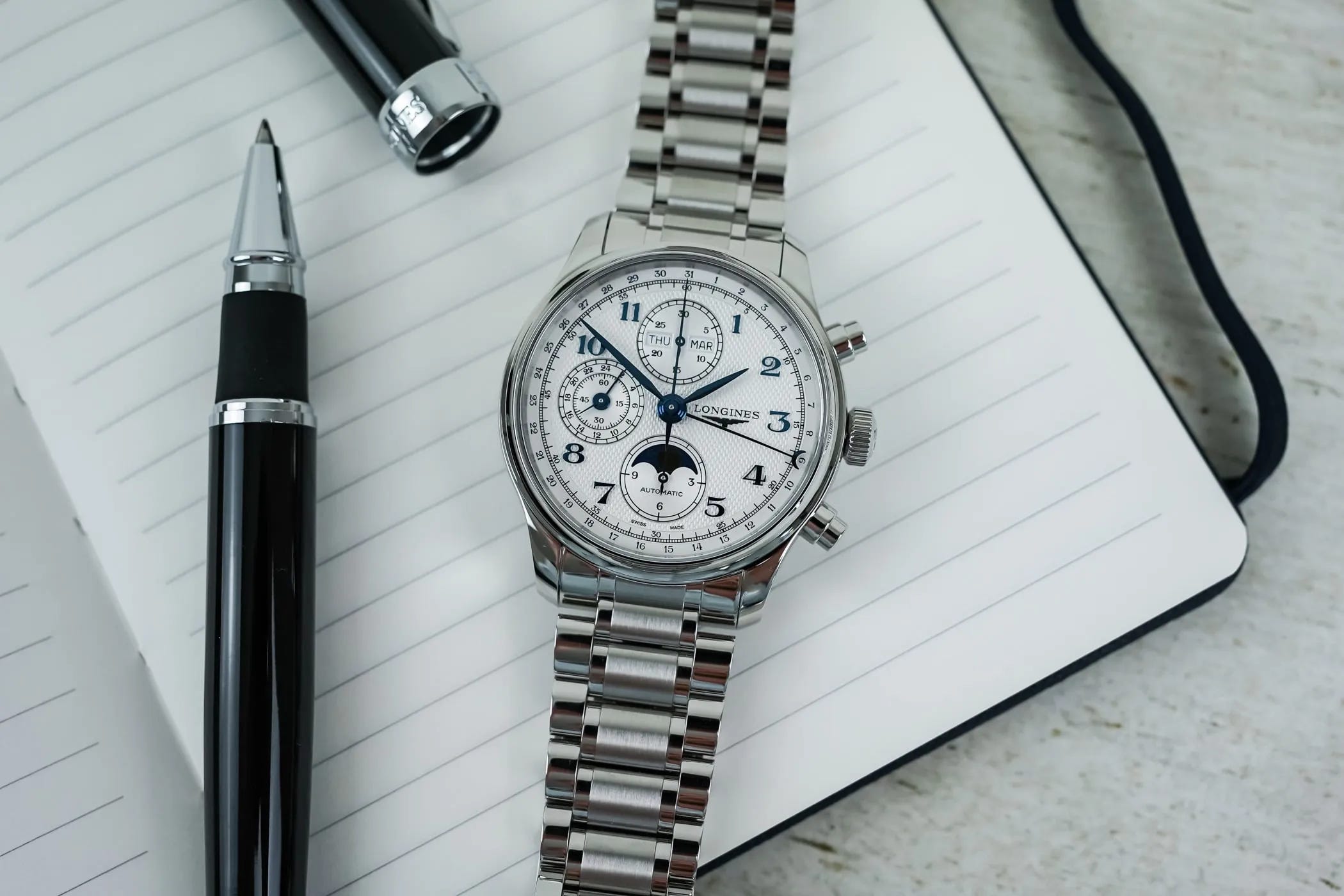
Longines Master Collection Chrono Monopusher
Longines is bringing the monopusher chronograph into the Master Collection with an unusually persuasive value proposition. The 41 mm steel watch uses the manual-wind L799.5 column-wheel movement, with a 68-hour power reserve and a vintage-minded pulsometer scale.
Available with light-blue or silver opaline dials, it has enough period charm to feel distinct while staying recognizably Longines. At $3,900, it may be one of the most approachable entries into a genuinely interesting chronograph format.
The Updated Longines Master Collection Gets Light-Blue Dials Go Deeper
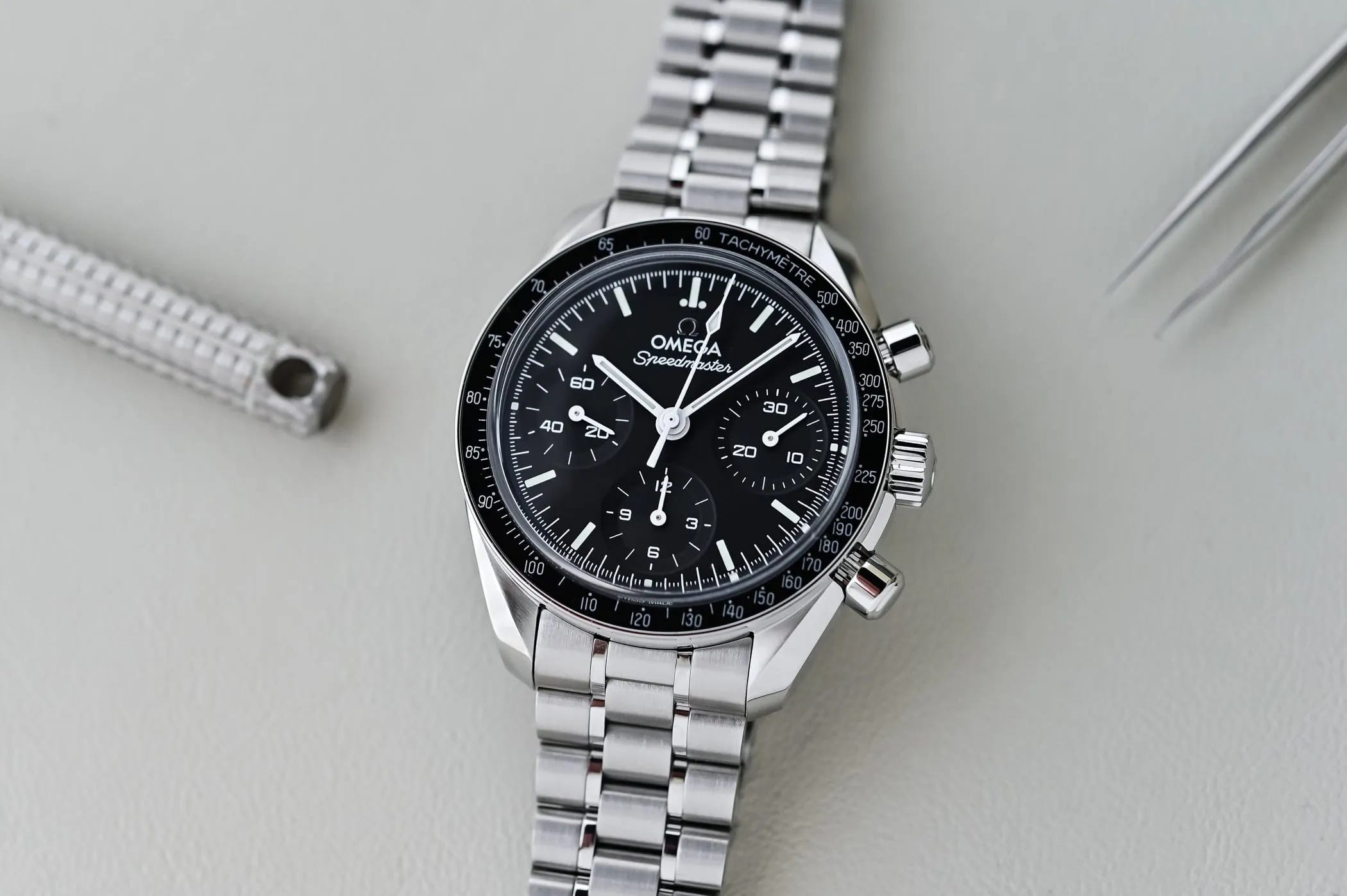
Omega Refreshes the Speedmaster 38 mm Collection
Omega’s new black-dial Speedmaster 38 brings the no-date, Moonwatch-adjacent look to a smaller automatic chronograph. It retains the asymmetrical case and lyre lugs, adds 100 meters of water resistance, and uses a column-wheel Co-Axial movement with a 52-hour reserve.
Six date-equipped models broaden the offering in steel, two-tone, and diamond-set configurations. The new collection is not trying to rewrite Speedmaster history; it is making the family more flexible.
Reinvented Royter Debuts Hand-Engraved Nova
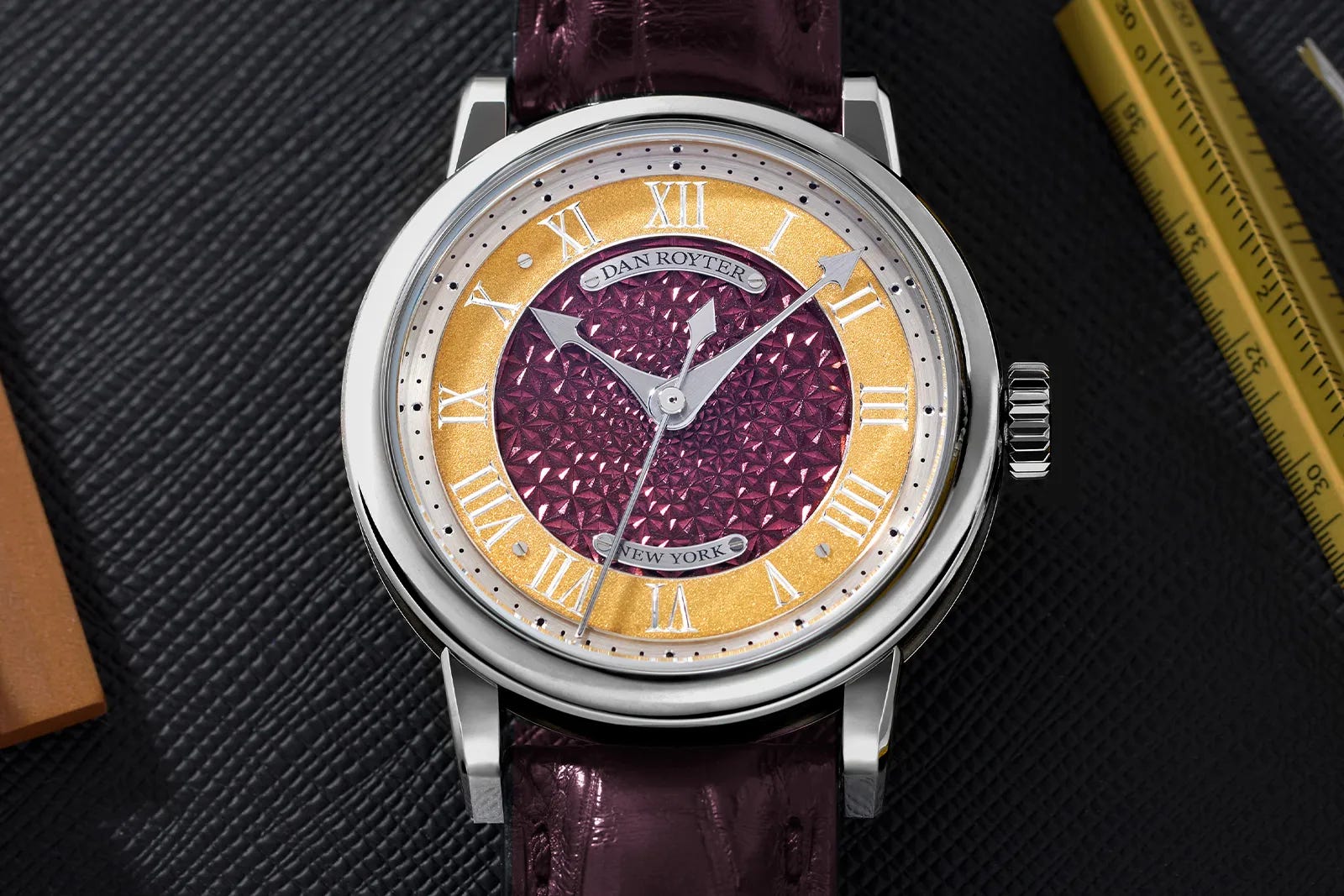
Brooklyn independent Royter moves far beyond white-label chronographs with the Legacy Nova Edition. Its burgundy-lacquered silver dial receives around twenty hours of freehand engraving, producing a dense field of tiny rhombuses beneath layers of lacquer.
The 39.3 mm steel watch is limited to twelve per year and uses the manual-wind BNR-01 movement. At $68,000, the Nova is an ambitious repositioning—but its real selling point is that the dial work looks like the work of a person, not a production line.
Doxa x Belmont Watches Sub 300 Beta “Frogger”
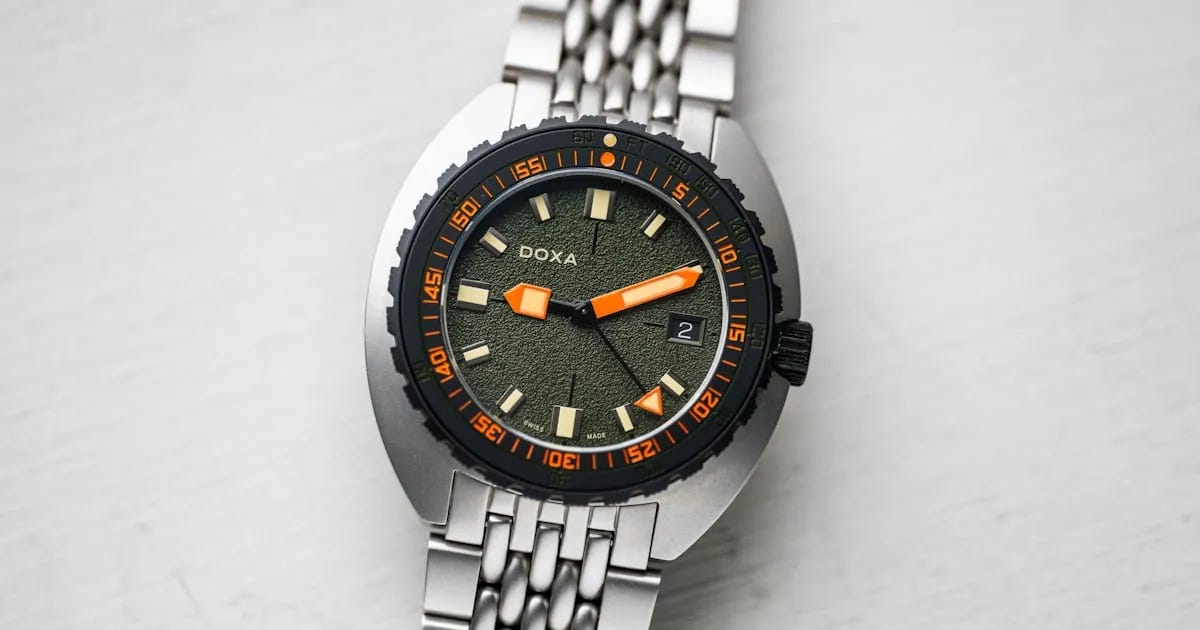
Doxa and Belmont Watches have created a thoroughly local dive watch for San Diego. The 42.5 mm Sub 300 Beta “Frogger” combines a kelp-green dial, sandblasted steel, blacked-out bezel and crown, and orange army-style hands, with a caseback that nods to the Navy SEAL Foundation.
Only 100 will be made, priced at $2,890, with part of the proceeds benefiting the foundation. Its best quality may be its restraint: the military references are clear without becoming costume.
This Limited Nodus Dive Watch Uses Sapphire for More Than the Crystal
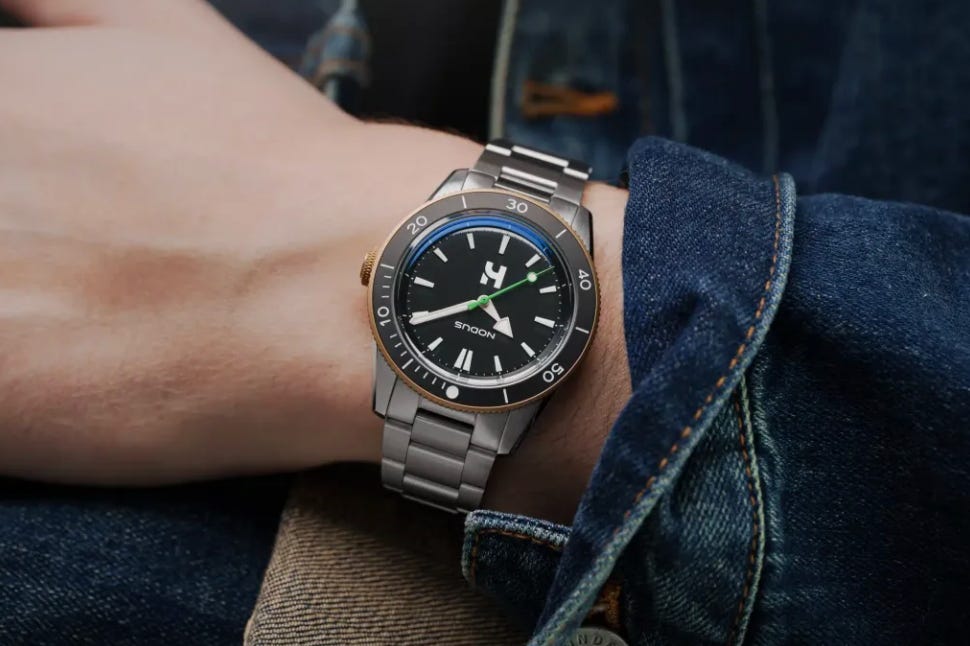
Nodus and Holme & Hadfield’s Sector II Dive H&H Edition uses a transparent sapphire plate as a dial-layer rather than merely a protective crystal. The result is a matte-black dial that feels deep and architectural, framed by bronze accents that will gradually develop their own character.
The 38 mm steel watch is limited to 75 pieces and priced at $650. Early access begins August 27 at noon Eastern, followed by general availability on August 28.
COMPARISONS
Does the Rolex Submariner Still Deserve to Be the Dive Watch Standard?
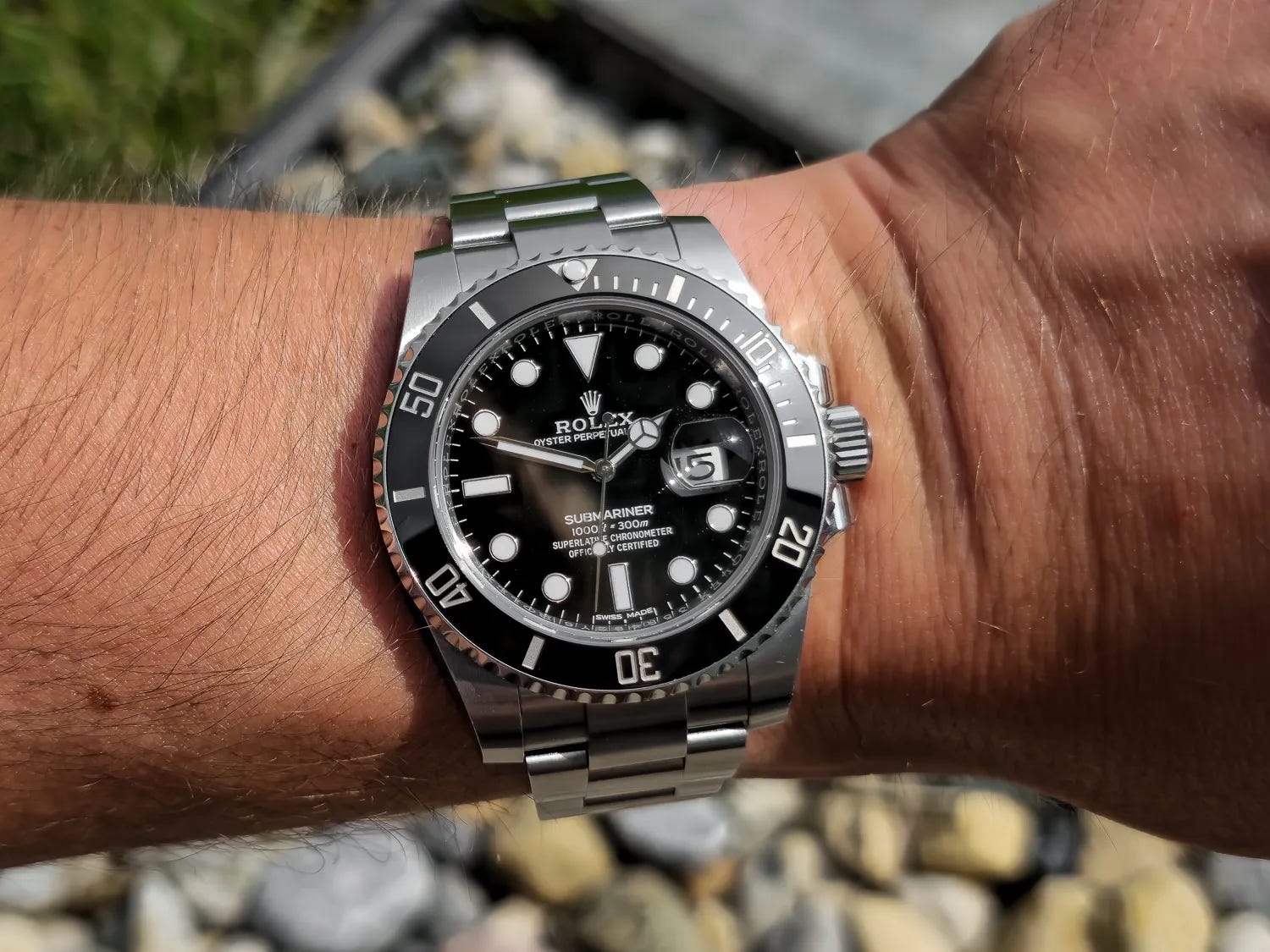
The Submariner still earns its reputation through proportion, ergonomics, bracelet design, and a look that moves easily between jeans and a jacket. Its Glidelock clasp and precise bezel remain benchmarks, but “the standard” is no longer synonymous with “the only answer.”
Tudor, Omega, Doxa, Citizen, Oris, Sinn, and others now offer more specialized, more colorful, more technical, or simply less expensive interpretations of the dive-watch brief. The Sub is still the reference point; it is just no longer the default conclusion.
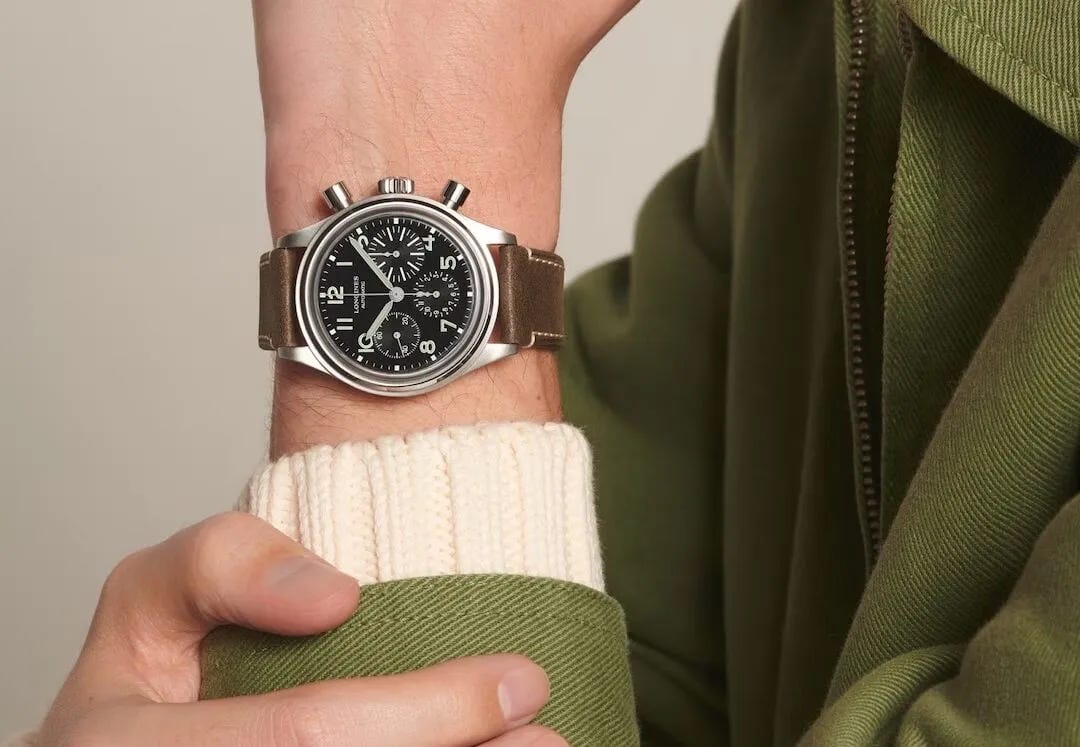
Silent Sleepers: The Best Watch Releases No One Talks About
Some of the strongest watches currently available are not the ones monopolizing collectors’ group chats. The Longines Avigation Bigeye, Grand Seiko SBGW283, Audemars Piguet Code 11.59 Selfwinding, Hermès Arceau Le Temps Voyageur, and Ralph Lauren Vintage 67 each offer a specific point of view without the usual frenzy.
The common thread is confidence. These are watches for collectors willing to choose design, movement, and wearing experience over the comfort of a familiar hype cycle.
REVIEWS
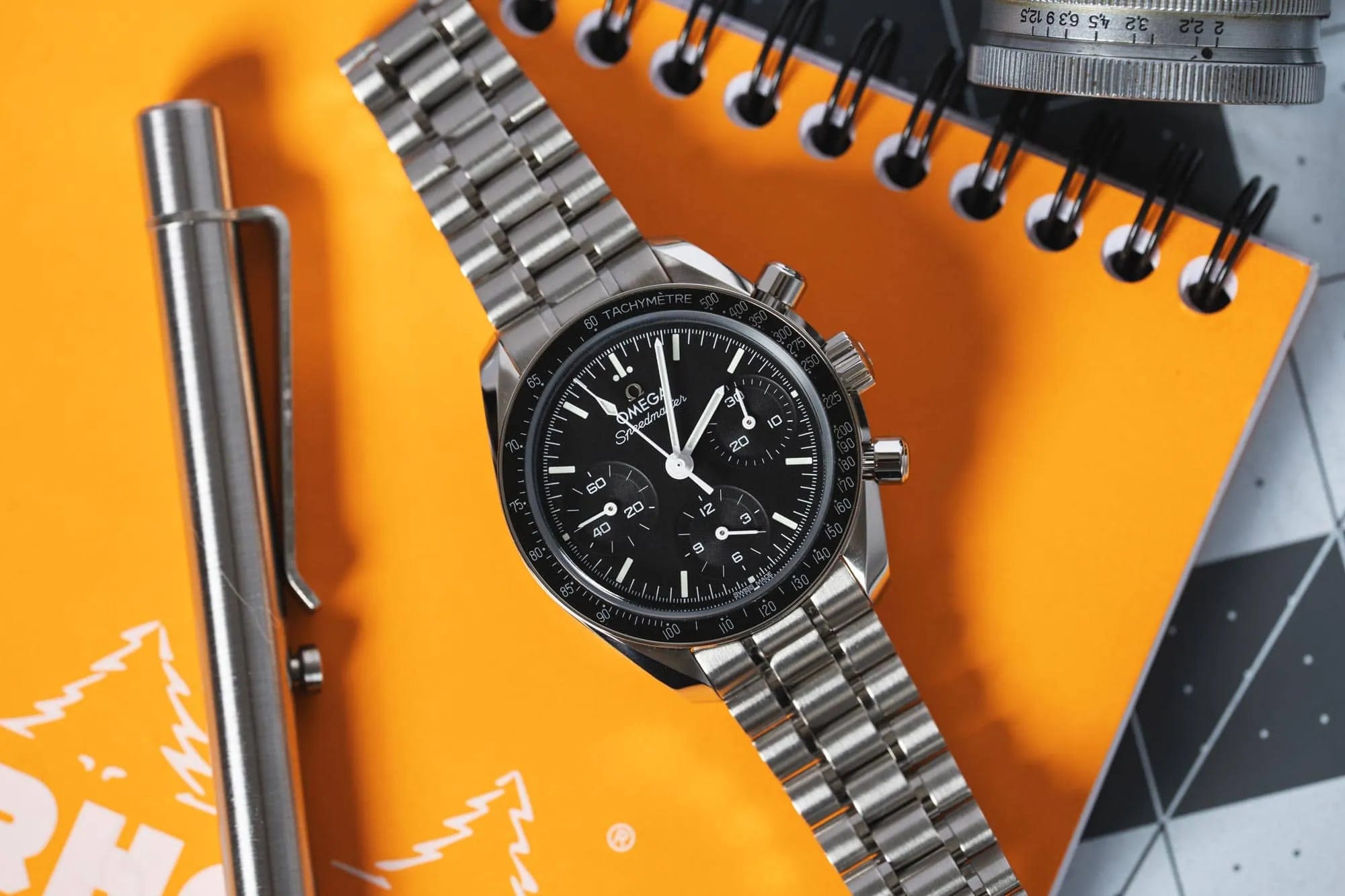
Is the New Omega Speedmaster 38 the Modern Speedmaster Reduced?
Omega’s revised Speedmaster 38 is arguably the closest modern successor to the old Speedmaster Reduced: compact, automatic, visually linked to the Moonwatch, and easier to live with day to day. The 38 mm case, black no-date dial, and 100-meter water resistance make a strong practical case.
At $6,500, it is meaningfully more expensive than a vintage Reduced, but also mechanically and technically more advanced. For collectors who love the Speedmaster look but do not need the Professional’s exact formula, it could be the right middle ground.
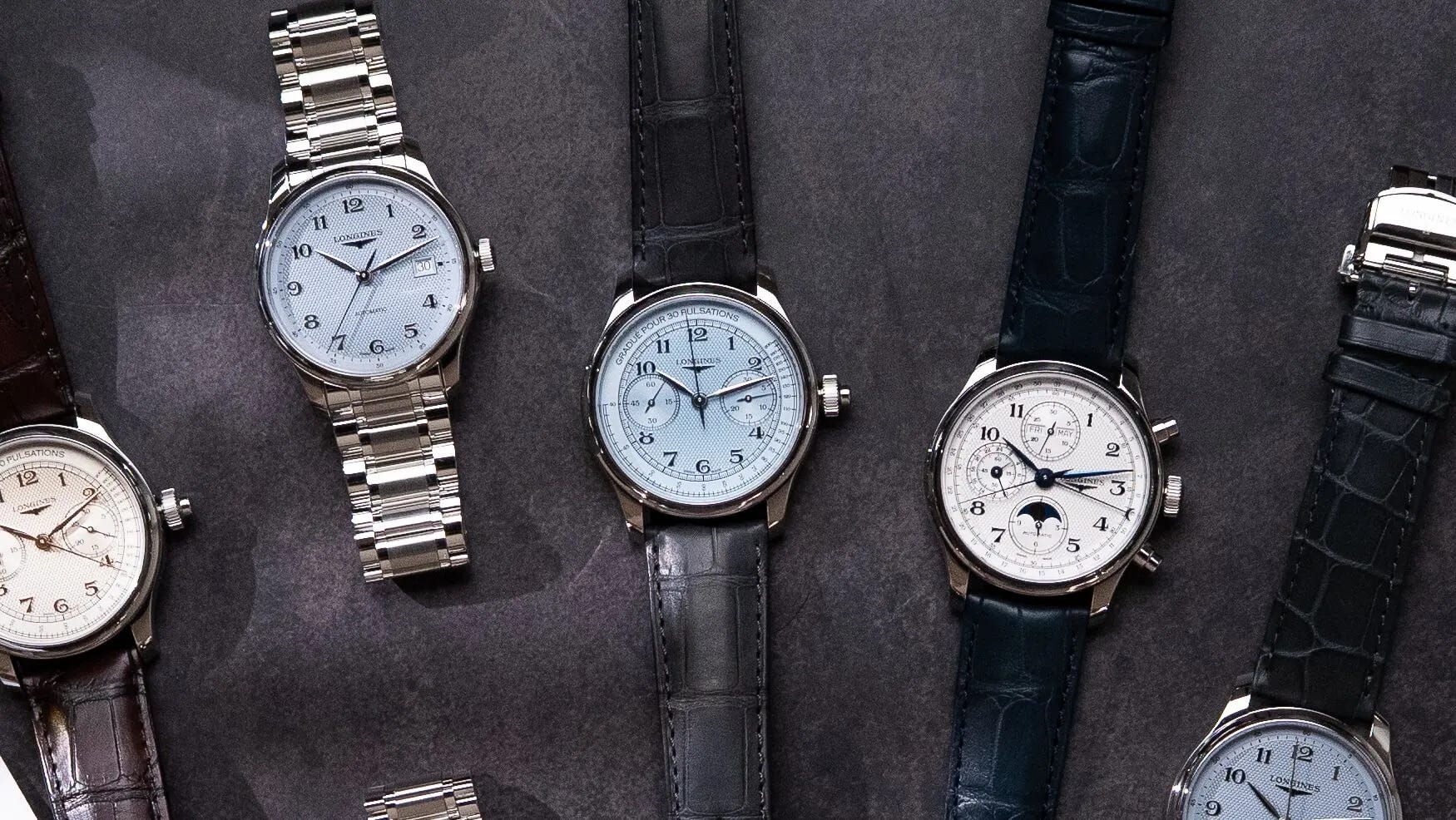
Longines Adds a Monopusher and More to Updated Master Collection
Longines’ updated Master Collection is a reminder that classic watchmaking need not be prohibitively expensive. New sizes, silicon balance springs, improved reserves, and updated bracelets elevate the everyday models, while the Chrono Moonphase and Chrono Monopusher bring proper complications into the mix.
With prices running from roughly $2,900 to $4,250, the collection makes a convincing case for Longines as the value-focused traditionalist of the Swatch Group portfolio.
Longines Impressively Expands the Master Collection - Go Deeper
The Longines Master Collection Launches a New Monopusher Chronograph Alongside a Refresh of the Triple Calendar Chrono - Go Deeper
The New Longines Master Chrono Monopusher - Go Deeper
The Updated Longines Master Chronograph Moonphase - Go Deeper
EVENTS
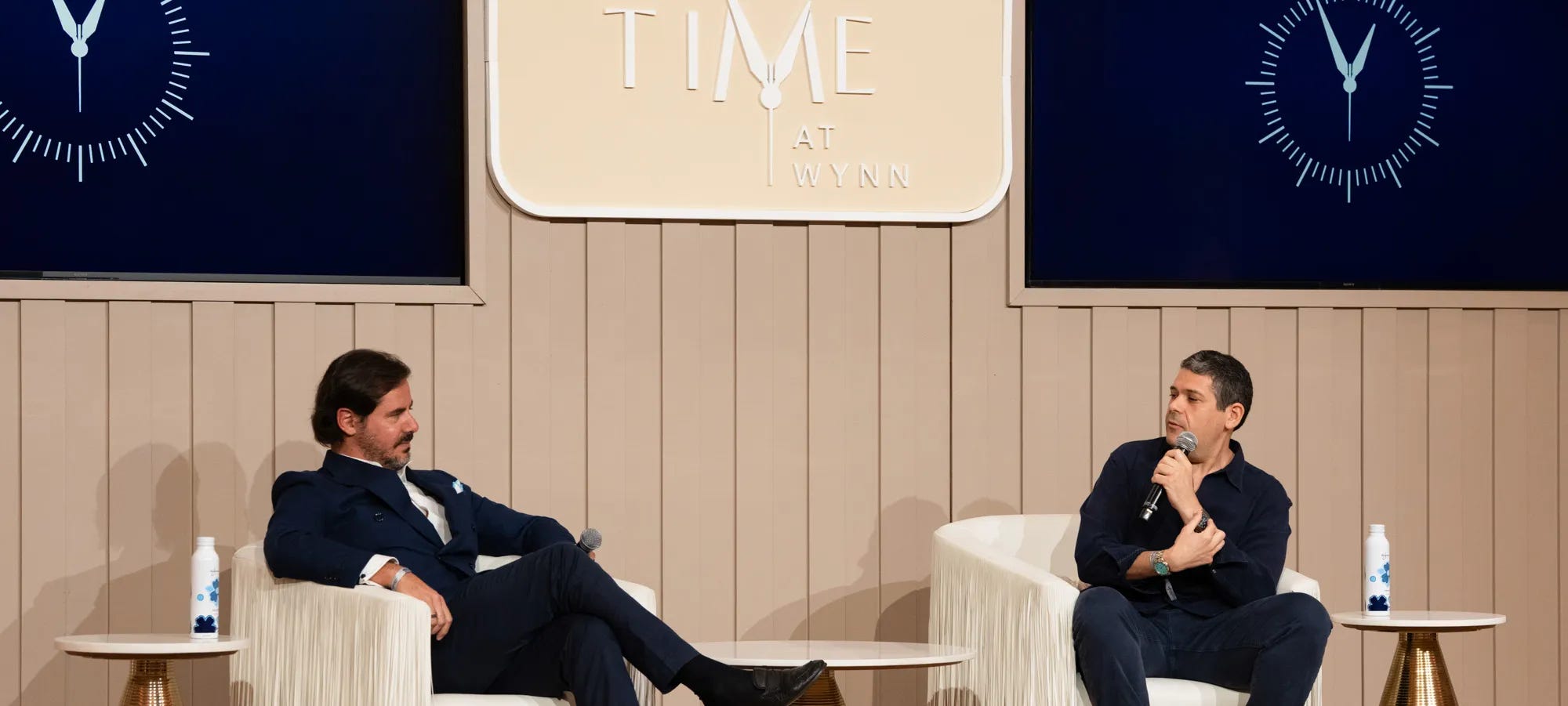
Inaugural ‘Time at Wynn’ High-End Watch Collectors’ Event Shines Light on Las Vegas
Time at Wynn arrived with an intelligent premise: let a luxury resort create a collector event around hospitality rather than another trade-show floor. Breguet, F.P. Journe, MB&F, Urwerk, H. Moser, Tiffany & Co., and other brands joined collectors, top clients, and media for a deliberately intimate two-day gathering.
Las Vegas has the client base, hotel infrastructure, and high-luxury retail ecosystem to become a serious U.S. watch destination. The first edition suggests that the city may finally be claiming that role.

Windup Watch Fair NYC 2026: The Biggest Watch Fair Around Just Got Bigger
Windup Watch Fair returns to Center415 from October 16–18 with more than 160 brands, free public access, and no registration requirement. Bremont, Brew, Bulova, Christopher Ward, and Oris are among the lead sponsors, while eBay Live will carry the fair to a wider audience.
The value of Windup is not just the number of watches under one roof. It lets enthusiasts handle watches, meet the people behind smaller brands, and discover something unexpected without needing an appointment or an allocation history.
PODCASTS
Fratello On Air: The Watches That Got Away
Mike and Balazs take on one of collecting’s most reliable sources of pain: the watches that got away. From a rare Citizen Jet Para Water Professional and a reverse-panda Daytona to a Movado M95, Heuer 2446, and a white-gold Day-Date 1803, the episode is a useful reminder that knowledge, timing, and decisiveness are rarely in perfect alignment.
The fun is in the honesty. Every collector has a watch they could have bought, should have kept, or only fully understood after the price had moved beyond reach.
Listen Now: Listen Now
Scottish Watches Podcast #808: Hell’s Bells — Helene Is Back for More Mayhem
Hélène returns for a characteristically wide-ranging conversation about a Fears Brunswick Orchid, a vintage Girard-Perregaux Gyromatic, an unexpected €40 Junghans, radium, fountain pens, Formula 1, Star Wars, and Star Trek. The watch talk is good, but the larger appeal is the argument for a more generous hobby.
It is a lively antidote to gatekeeping: learn the details, share them freely, and leave room for joy.
Listen Now: Listen Now
VIDEO
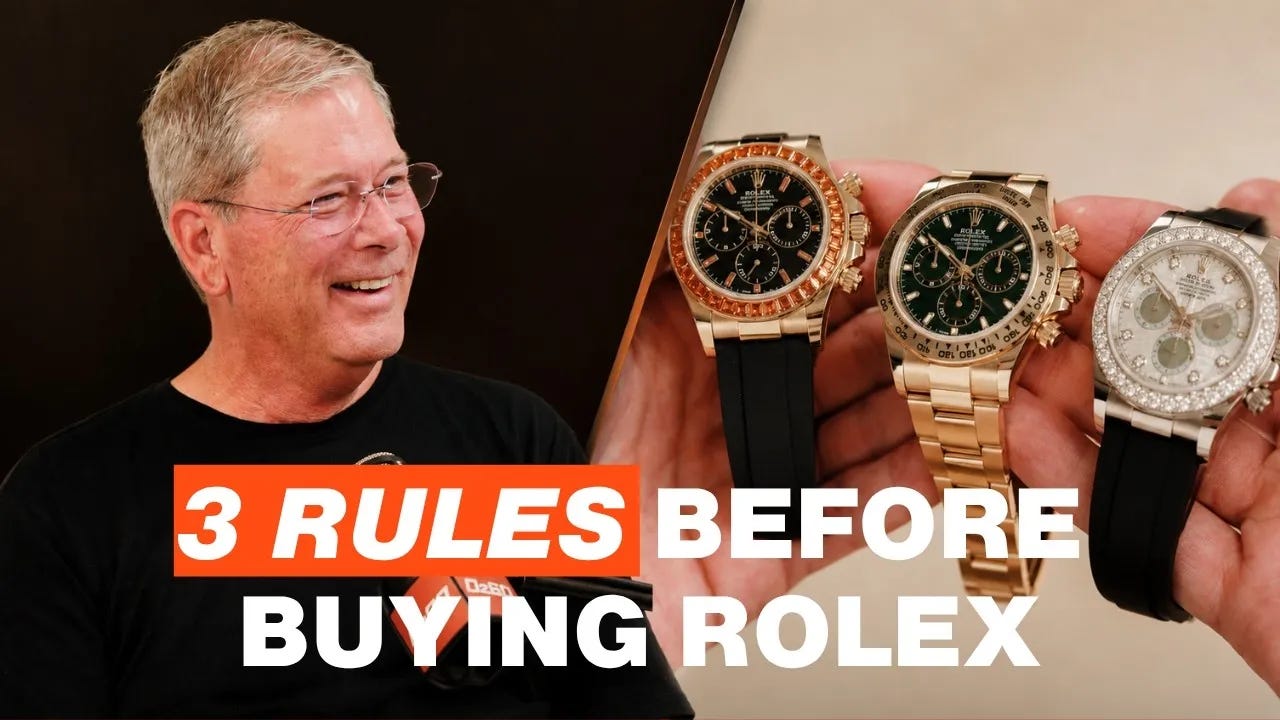
DO NOT Walk Into Rolex Until You Know This!
A practical primer on approaching the Rolex boutique experience with clearer expectations around availability, sales processes, and the difference between wanting a watch and being offered one.
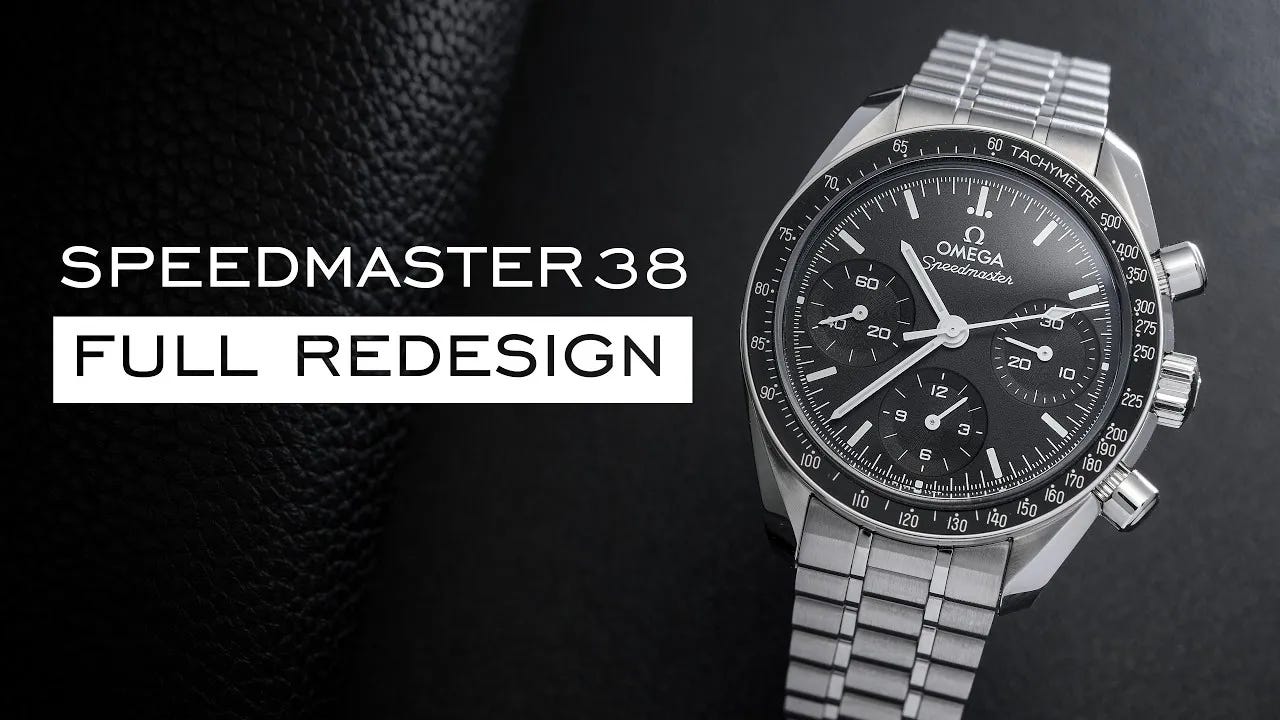
Omega Finally Brought Moonwatch Looks to the Speedmaster 38
Teddy Baldassarre examines how the redesigned Speedmaster 38 imports more of the Moonwatch’s familiar visual language into a smaller automatic package.

There’s a Waiting List for Fake Watches???
Cool_lectibles looks at the strange economics of hype around counterfeit watches and what that demand says about status, branding, and the appetite for luxury signals.

Real Rolex AD Story 2026 — Insane Levels of Entitlement
Scott Adam Lancaster considers how Rolex retail culture and luxury advertising can amplify expectation, hierarchy, and entitlement around a product that is, at heart, still a wristwatch.
Watch Now: Watch Now

Why the New Omega Speedmaster’s Biggest Flaw Isn’t That Bad
A live Q&A on the compromise at the center of the new Speedmaster and whether it meaningfully changes the watch’s appeal for prospective owners.
AUCTION RESULTS
Chopard L.U.C Time Traveler One Misses Reserve at $9,701
The August 25 auction of the 2024 Chopard L.U.C Time Traveler One 42 Titanium, limited to 250 pieces, reached $9,701 but did not meet its reserve. With typical secondary-market trading cited between $13,000 and $19,000, the bid landed roughly 25 percent below the bottom of that range.
The result is another useful reminder that a modern limited edition can be attractive, technically accomplished, and still struggle to create urgency at auction when the reserve is set ahead of observable market demand.
TODAY’S AUCTION
Breguet Classique Tourbillon Messidor in Rose Gold, Ref. 5335BR/42/9W6
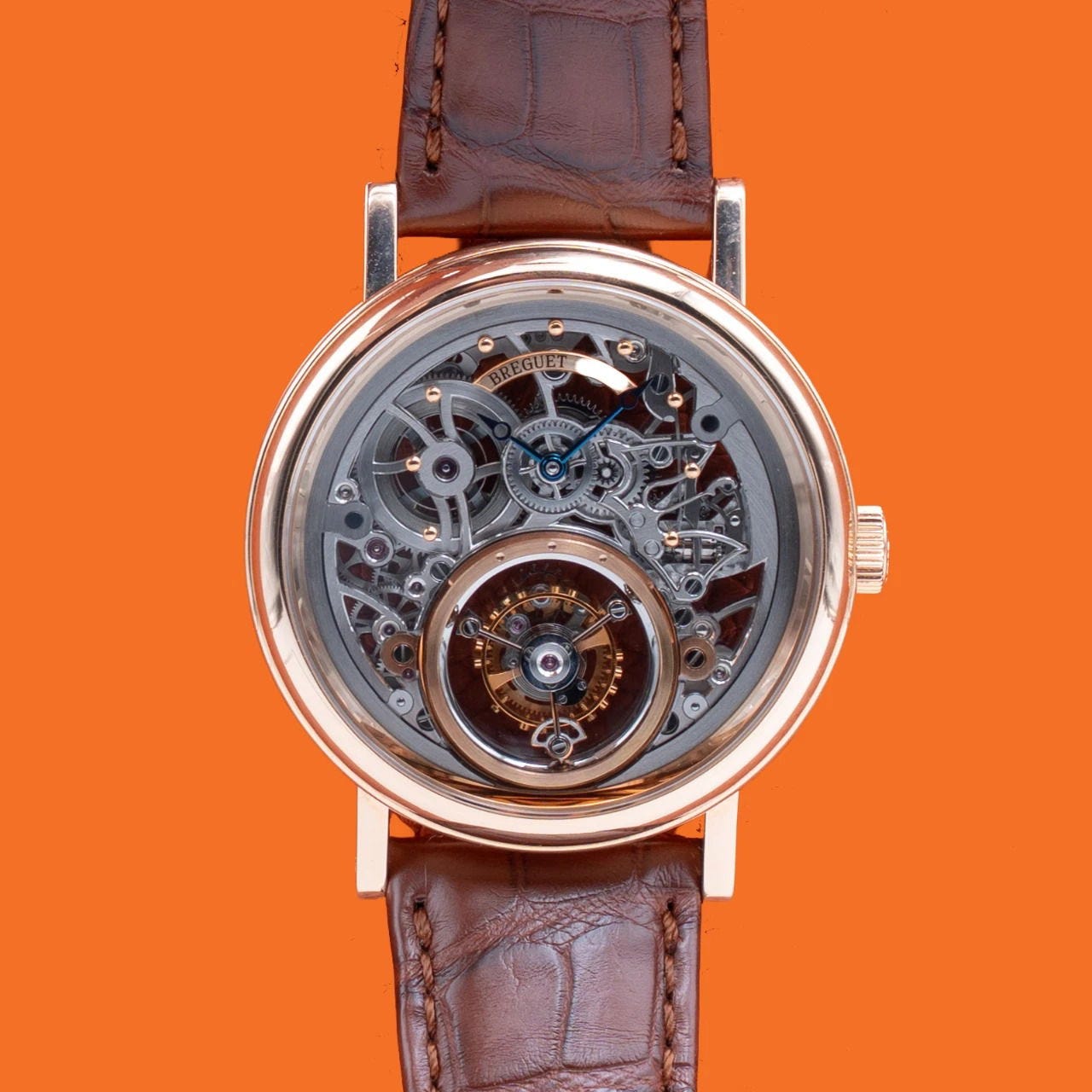
The Breguet Classique Tourbillon Messidor ref. 5335BR/42/9W6 is a watch designed to make one of horology’s oldest complications look improbable. In a 40 mm rose-gold case, the hand-wound calibre 558 SQ2 places a skeletonized tourbillon at the center of the experience, using an “invisible” bridge construction that makes the rotating cage appear suspended. The model’s name refers to 7 Messidor, Year IX—June 26, 1801—the date Abraham-Louis Breguet patented the tourbillon.
It is a serious watch in every traditional sense: 18k rose gold, 201 movement components, 25 jewels, a Breguet overcoil, a 50-hour reserve, 30-meter water resistance, and the kind of hand finishing that rewards close inspection. The off-center time display leaves the architecture exposed rather than treating it as a hidden engine. That is the Messidor’s appeal: it is not a tourbillon added to a conventional dial, but a watch constructed around the visual drama of the regulator itself.
The market, however, has never valued this particular sort of Breguet complication in lockstep with its retail price. Recent comparable rose-gold Messidor examples have been offered around the low-$60,000 range, while a comparable full-set rose-gold example sold at auction for about $61,900 in 2025. That does not diminish the watch’s quality; it simply makes the Messidor a watch where informed buyers should distinguish carefully between retail positioning, dealer asking prices, and completed public sales.
This 2019 example has the right ownership essentials—box and papers—and presents as a worn, polished watch rather than an untouched collector piece. That makes the bidding discipline straightforward. Its rarity and technical charm are real, but its value is best judged against the limited pool of comparable transactions, not against the much higher cost of a new grand complication. The supplied auction schedule lists the close at 4:15 p.m. EDT today, Tuesday, August 25.
Current bid: $33,501
Losing Time


Today’s Big Losers at Auction on Grailzee
Failed-Sale Report: Four Watches, Four Reality Checks
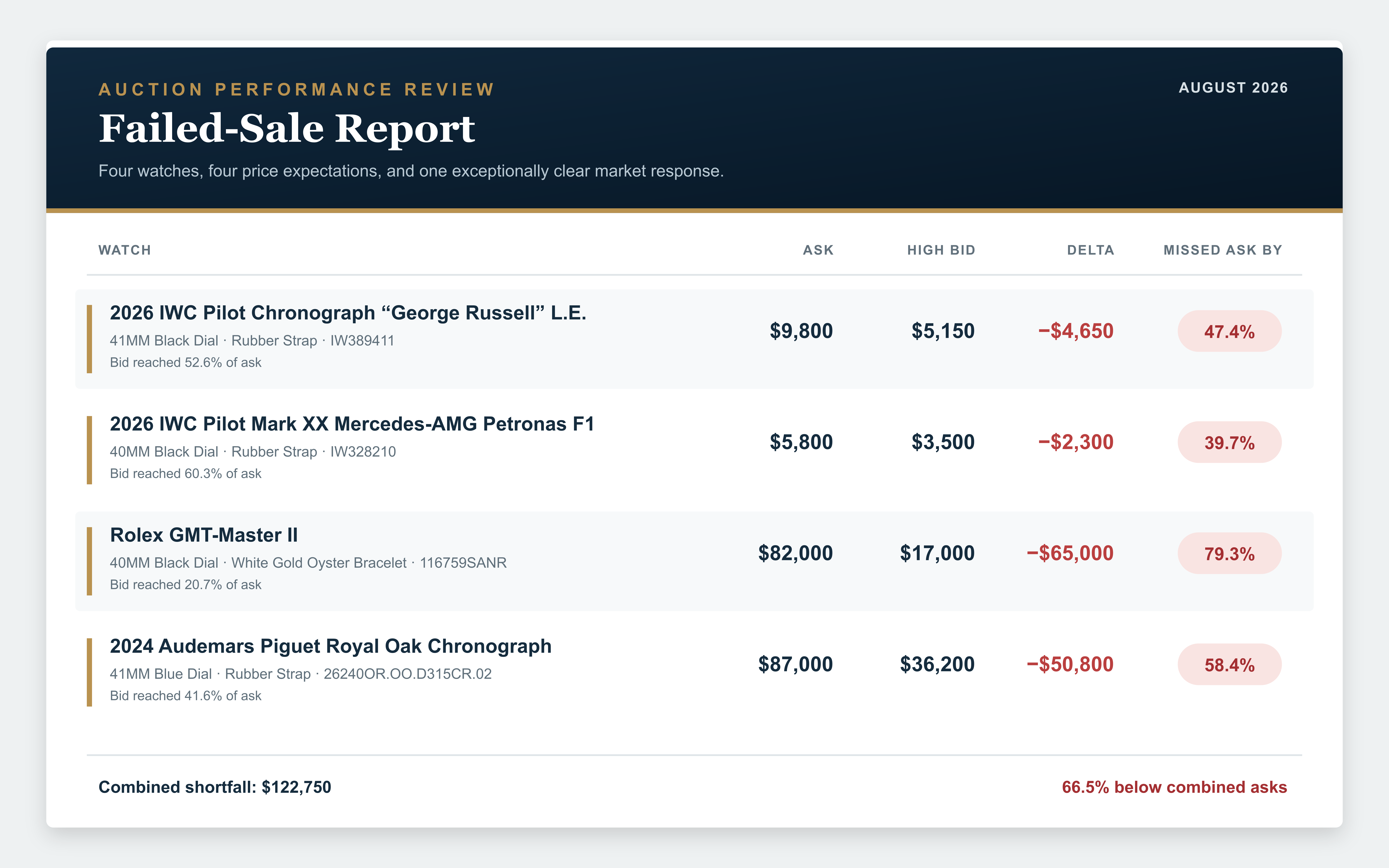
Across all four watches, the combined ask was $184,600 and total bidding reached $61,850—leaving a $122,750 shortfall. Put differently, bidders collectively got only 33.5% of the way to the sellers’ expectations. The market did attend the meeting; it simply declined the proposed agenda.
IWC Pilot Chronograph “George Russell” L.E.
The George Russell limited edition was offered at $9,800 and topped out at $5,150, leaving a $4,650 shortfall. The bid reached 52.6% of ask, meaning the seller needed to come down 47.4% to meet the best available buyer.
For a current, branded limited edition, that is a fairly emphatic message: the F1 association may be interesting, but it did not persuade bidders to pay anywhere near the retail-adjacent ambition. There was buying interest, just not at a price that required a racing helmet and a suspension of disbelief.
IWC Pilot Mark XX Mercedes-AMG Petronas F1
The Petronas Mark XX was the strongest performer of the group. Against a $5,800 ask, it attracted a $3,500 high bid, a $2,300 gap. That bid represented 60.3% of ask, with the seller needing a 39.7% adjustment to clear.
This is still a failed sale, but it is the least dramatic one. The market appears to see a real value proposition around the mid-$3,000 range; the seller appears to see one closer to $5,800. Both are entitled to their opinions, but only one of them showed up with money.
Rolex GMT-Master II White Gold
The Rolex was the clearest disconnect. An $82,000 ask met a $17,000 bid, producing a $65,000 deficit. The bid achieved only 20.7% of ask—79.3% below the requested price.
Even allowing for auction dynamics, condition, completeness, and the narrower buyer pool for a white-gold gem-set GMT, this was not a near miss. It was a case of the market looking at the ask and choosing a different time zone. The bidding suggests interest at a materially lower level, not a buyer base waiting just below $82,000.
Audemars Piguet Royal Oak Chronograph
The 2024 Royal Oak Chronograph was offered at $87,000 and reached $36,200, leaving a $50,800 gap. The high bid represented 41.6% of ask, or a 58.4% miss.
The result signals that the watch has considerable liquidity at the right number, but the ask was far ahead of the room. A $36,200 bid is not a lack of interest; it is the market offering a very specific opinion about where the risk, demand, and current premium belong.
Bottom Line
The two IWCs were comparatively close, particularly the Petronas Mark XX, and could plausibly transact with a disciplined repricing. The AP requires a far more substantial reset, while the Rolex result indicates the largest gap between seller expectations and demonstrated demand.
None of these sales failed because no one cared. They failed because the bids established one market and the asks were operating in another.
Thank you for spending part of your day with BuyingTime. Keep looking closely, ask better questions, and buy the watches that will still have something to say after the hype has moved on.